ARM HA-IPB University Launches a 10 Steps of Training Program on Preventing and Addressing Violence
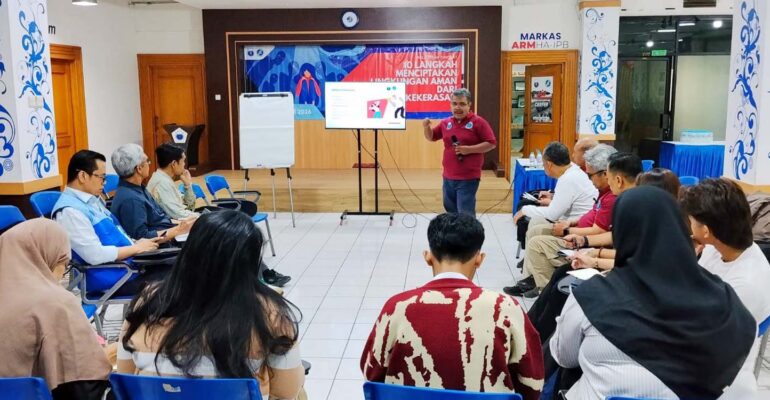
Amid the recent surge in reports of violence, including cases of sexual violence in the community and on college campuses, the Independent Volunteer Action of the IPB University Alumni Association (ARM HA) initiated a short training session on awareness, prevention, and handling of violence titled “10 Steps to Creating a Safe Environment Free from Violence” on Saturday (5/9) at the IPB Alumni Building, Baranangsiang, Bogor City.
The training, which is part of the ARM HA-IPB Learning Class, was attended by 25 ARM HA-IPB executives and volunteers, as well as IPB Student Volunteers (REMI) from the Student Executive Board-Student Association (BEM KM).
“This training introduced participants to the concepts, definitions, and types of violence occurring within the community, particularly interpersonal violence,” said ARM HA-IPB Chairman Ir Ahmad Husein, M.Si., who served as the training facilitator. Husein is a graduate of the first cohort of the “Global Trainer of Trainers on Protection, Gender, and Inclusion (PGI) in Emergencies” program organized by the International Federation of Red Cross and Red Crescent Societies (IFRC) in Istanbul, Turkey, in 2018.
He added, “Many people are not yet aware that violence can occur anywhere whether at home, at work, in schools and on campuses, in public spaces, or even in disaster affected areas.”
The 10 Step Approach was first developed by the Canadian Red Cross and introduced to Indonesia through the Indonesian Red Cross (PMI) beginning in 2011. This approach is considered systematic and provides detailed guidance for organizations and community groups in understanding the concept of violence, mapping issues, forming prevention teams, establishing response mechanisms, and maintaining an environment free from violence.
The training combined presentations, discussions, quizzes, group work, and educational games to help participants gain a deeper understanding of the urgency of preventing and addressing violence. Through games and discussions, participants also learned about the psychological impacts experienced by survivors of violence.
“This training made me realize that violence isn’t always physical, it can also take the form of words, pressure, intimidation, and verbal abuse,” said Rudi Hartono, one of the participants. As the General Treasurer of ARM HA-IPB, he is committed to becoming part of the group of people who will support, listen to, respect, and protect others from violence over the next six months.
M Zaki Al Ghifari, a REMI volunteer from the 62nd Batch of the Faculty of Forestry and the Environment, said this training is highly relevant given the current surge in cases. “I haven’t experienced it personally, but I’ve witnessed acts of violence happening around me,” Zaki explained. What left the deepest impression on Zaki was the role-play session, when all participants witnessed a visualization of the psychological impact and trauma experienced by victims or survivors of violence. “I will share the knowledge and experience from this training with those closest to me,” he said.
Meanwhile, Rashaqa Dildara Syahrul, a REMI Batch 62 volunteer from the School of Business, admitted she now better understands how to recognize, avoid, and address acts of violence occurring around her. She was particularly interested in the concept of the bystander within the 10 Step Approach, which is crucial for stopping acts of violence. “My message to my fellow IPB students is that violence must be eliminated. Bystanders must have the courage to step forward, take a stand, and act to support survivors,” she emphasized.
As one of the follow up actions from the training, ARM HA-IPB plans to form a Violence Prevention and Response Team. Regarding the Learning Class program, the Chairman of Volunteer Management, Ir Agus Susilo JP, stated, “This is the inaugural session, and we are preparing the next training with topics relevant to volunteer humanitarian work or current public issues that require a response.” (*/Rz) (IAAS/KQA)