
This Korean researcher explains the results of his study of Bonobo Primates in the Department of Biology, IPB University
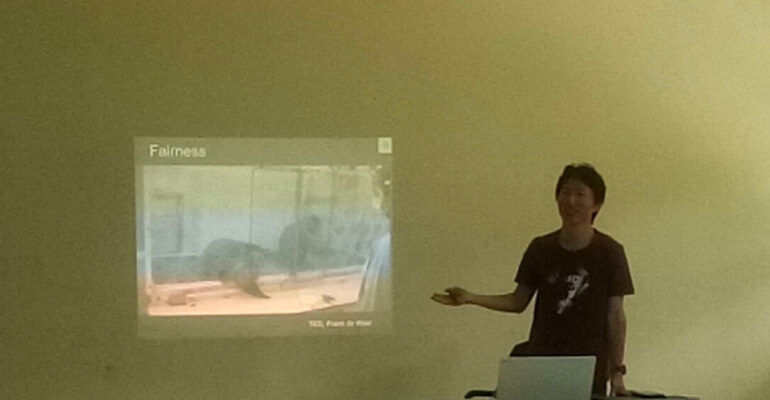
Bonobo is one of the large primates closely related to chimpanzees. These primates are interesting to study because they can be used to study other aspects of the life of living things, one of which is about the aging or aging of a species. The presentation about Bonobo was delivered by Heungjin Ryu, PhD from the Primate Research Institute, Kyoto University, Japan while giving a guest lecture at the Department of Biology, Faculty of Mathematics and Natural Sciences (FMIPA), IPB University, at Dramaga Campus, Bogor (16/08).
“We often hear opinions about one year of dog life is ten years of human life. If that is true, this opinion cannot be applied to Bonobo who in his wild life can live up to fifty years, “Heungjin said in his presentation. He also explained that by comparing the occurrence of aging in the Bonobo eye organ with the human eye organ, this opinion is incorrect. Two years of human life is not comparable to one year of Bonobo life.
According to Heungjin, the distance between Bonobo’s hands and eyes changes with age. Heungjin also showed a picture when showing a picture of two Bonobos aged twenty-seven years and forty-five years who were looking for fleas with the longest hand-to-eye range owned by forty-five-year-old Bonobo.
Heungjin further explained that human far vision develops rapidly when humans reach the age of forty years. The average human at forty-five years needs about twenty centimeters to get a clear focus on an object (the closest focus distance). When humans reach the age of fifty, the closest focusing distance becomes forty centimeters.
“My study found that changes depend on age in the closest focus distance. “Both Bonobo and humans do not have a difference in this matter, so this data cannot yet provide a difference in longevity between the two species,” Heungjin said in his presentation.
Heungjin further explained that although more data were used on aging in other parts of the body, there was not much difference in the aging of other parts of the body. For example, female chimpanzees in the wild usually stop reproducing at the age of fifty, which is almost the same as female humans.
At the end of the presentation Heungjin concluded that studying primates can help to understand humans better. For example the evolution of the aging system and the mating system of living things. The speed of aging of various species reflects their mating system which is a form of adaptation of living things to natural selection.
“At present wild primates are very threatened and we need more conservation and conservation efforts so that benefits can continue to be felt,” Heungjin concluded to the guest lecturer participants who came from among lecturers and undergraduate students as well as postgraduate students at IPB University. (LR / Zul)

