Present at IPB, Chairman of Zakat and Endowment Commission of Nigeria Promotes Tree Waqf
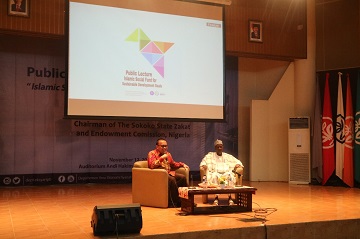
Chairman of Zakat and Endowment Commission of Sokoto State, Nigeria, Mohammad Lawal Maidoki said that zakat and endowment has many benefit for community and environment. At least there are six aspects that will obtain the benefit of zakat and endowment. Those six aspects are spiritual, environmental, economical, social, nutritional, and medical. Those aspects can be fulfilled by using the concept of tree endowment.
“Through the movement of tree endowment, we can improve community well-being without damage the environment. Contrarily by this tree endowment environment can be more conserved and more sustained,” said Mohammad Lawal.
In Nigeria, the concept of tree endowment has been implemented for a long time and has given satisfying result. It is because by planting tress, people may enjoy its benefits not only once, but they can enjoy it multiple times as long as the trees are able to produce fruits. This tree endowment is not limited only for adults, but children also can give tree endowment. By endowing one tree, a child can obtain the benefit after the next five years, depends on the age when the tree starts producing fruit.
On the other side, zakat distribution in Sokoto, Nigeria is given to women and children. More than 50 percent of zakat’s mustahiq or zakat receivers in Sokoto, Nigeria are women while only 20 percent zakat receivers are men. Zakat which has been given to mustahiq is used as poverty alleviation program in that city.
This matter was delivered by Maidoki when holding General Lecture “Islamic Social Fund for Sustainable Development Goals”, Thursday (13/11) at Andi Hakin Nasoetion Auditorium, IPB Dramaga Campus, Bogor. This activity was held by Department of Sharia Economic Science, Faculty of Economics and Management, Bogor Agricultural University (FEM IPB).
By copying the policy in Sokoto, Nigeria, Dr. Asep Nurhalim, Lc., M.Pd.I., Head of Department of Sharia Economic Science IPB encouraged zakat institution to utilize zakat as the instrument of sustainable development. Not only to achieve prosperous community, Dr. Asep hope with zakat and endowment, environmental welfare also can be maintained.
“Zakat and endowment are not only about receiving and distributing it, but it must have target or programs which can shift a mustahiq to become a muzaqi,” explained Dr. Asep.
Dr. Asep confessed that currently Indonesia people still need the education about zakat and waqf. Although there are already institutions that manage zakat and endowment, people still need to get enlightenment about that zakat and endowment. Some matters that must be informed to people about zakat and endowment are the urgency of zakat payment, benefits and functions of zakat, zakat allocation and parties who are obliged to pay zakat and also who are entitled to receive zakat. (qa)