IPB Tests Sea Surface Drones in Riau Islands
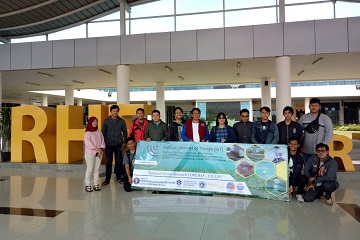
The team from the Instrumentation and Marine Robotics Laboratory, Department of Marine Science and Technology, Faculty of Fisheries and Marine Sciences, IPB University (FPIK IPB) re-introduced the results of the development of the latest marine technology. This time it is in the form of an Autonomous Surface Vehicle innovation. Drones that are developed are in the form of a two-meter-long catamaran (double hull). The drone operation is not done through a remote control but by entering the computer program into the electronic box on the drone first. The computer program contains commands about the direction of movement of drones in the form of points to be passed or waypoints or trajectories taken.
Drones that have been developed can be used to monitor the condition of coastal aquatic ecosystems, such as seagrass, coral reef, goba (lagoon) and others. Data and information that has been produced from sea level drones, including underwater cam video footage that is crossed by drones, water depth (bathymetry), water brightness, chlorophyll, and the position of drones from time to time. Drones can display live "live streaming" images underwater to a laptop or computer operator. In addition, drones are also equipped with data loggers to store observational data to be replayed or analyzed further.
Field trials of Sea Surface Drones have been successfully carried out in the waters of the Seagrass Conservation Area, Bintan Island, Riau Islands (KEPRI). The development of Sea Surface Drones is part of the Internet of Things of Seagrass aimed at developing an observation system and database on seagrass ecosystems. This development research is funded through DDRG (Demand Driven Research Grant) Coremap-Indonesian Institute of Sciences (LIPI).
According to the Team Leader, Prof. Dr. Indra Jaya, Indonesia as a vast archipelagic country and a complete tropical coastal ecosystem, desperately needs the latest technology such as sea level drones. "This drone is expected to be able to complement and even fill the vacuum of survey and monitoring equipment in coastal waters that are still difficult to reach by research vessels because the waters are relatively shallow and dangerous for ships. With the availability of basic data and information related to existing ecosystems, Indonesia can accelerate the development and realize the potential of natural wealth for people's welfare," explained Prof. Indra Jaya.