PSA IPB University, Indonesian Peasants Union, and Insist Press Review Three Agrarian Books
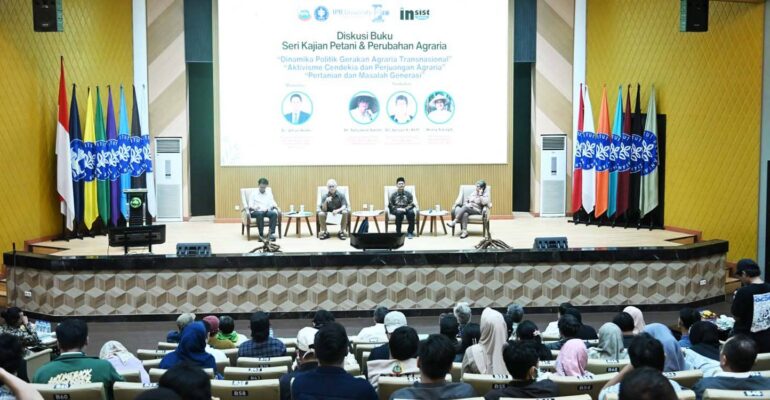
The Center for Agraria Studies (PSA) of IPB University, in collaboration with the Indonesian Peasants Union (SPI) and Insist Press, launched a series of three books on peasant studies and agrarian change at the Andi Hakim Nasution Auditorium, IPB Dramaga Campus (2/2).
This moment served as a space for reflection as well as the strengthening of agrarian discourse amidst the evolving dynamics of development and social change.
The three translated works by Saturnino M Borras Jr and Ben White introduced at the launch include The Political Dynamics of Transnational Agrarian Movements, Scholar-Activism and Agrarian Struggles, and Agriculture and the Generation Problem. The event also featured a discussion on critical agrarian thought involving academics, activists, and representatives of peasant movements.
The Vice Rector of IPB University for Research, Innovation, and Agromaritime Development, Prof Ernan Rustiadi, emphasized that critical agrarian thought remains relevant in addressing various development challenges.
“Some believe these thoughts are fading away, but others argue they must be aligned with current developments,” he stated.
Prof Ernan also highlighted several of the current government’s populist development programs. Programs such as Free Nutritious Meals (MBG), Folk Schools, and Free Health Check ups (PKG) indicate efforts to reduce social inequality. Simultaneously, various balancing ideas serve as a response to the disparities that still exist across various sectors.
Echoing this sentiment, the Chief of PSA IPB University, Dr Bayu Eka Yulian, noted the importance of public access to agrarian knowledge. He assessed that current global knowledge circulation tends to follow market logic.
“The circulation of knowledge at the global level leads us to reflect on how knowledge is produced, valued, circulated, exchanged, and utilized much like a commodity. We might call this the industrialization of knowledge,” he explained.
Therefore, he stressed the need for efforts to ensure that knowledge remains accessible to farmers and rural communities.
From the perspective of peasant movements, the General Chairperson of SPI, Henry Saragih, considered these books an important entry point for understanding the dynamics of agrarian struggle, both nationally and internationally. He highlighted how transnational peasant movements have been strengthening since the 1990s.
“This book can guide us in examining why farmers in the Netherlands, France, and other countries can struggle at an international level and unite with farmers from the Global South,” he remarked.
Meanwhile, one of the book’s authors, Saturnino M Borras Jr, emphasized that the experiences of local farming communities, indigenous peoples, and social movements play a vital role in driving social transformation.
According to Borras, agrarian issues will become increasingly strategic as they relate directly to the control of natural resources, such as land, water, forests, seas, and even renewable energy.
“Today, everyone wants to control nature, whether in the context of war, climate change, food, or mining for renewable energy. Therefore, the agrarian struggle will become increasingly important,” he asserted.
Moving forward, these three books will be available for free through the official Insist Press website to expand the distribution of agrarian knowledge and strengthen public literacy, particularly for farmers, fisherfolk, and rural youth. (AS) (IAAS/HNF)