
On National Farmers’ Day, Dean of IPB University’s Faculty of Agriculture: Conversion of Rice Fields is Alarming
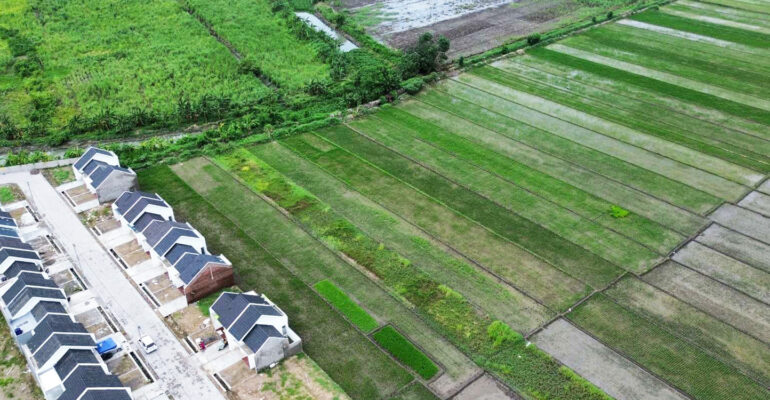
Dean of IPB University’s Faculty of Agriculture, Prof Suryo Wiyono, emphasized that the trend of converting rice fields in Indonesia has reached an alarming stage. He made this statement on National Farmers’ Day, September 24.
“Our rice field area is only around 7,3 million hectares. Compared to other countries, this figure is very small. Globally, Indonesia ranks 130th out of 180 countries in terms of agricultural land availability per capita. This situation has an impact on our low Global Food Security Index,” said Prof Suryo.
Based on data from the Ministry of Agriculture and the Central Statistics Agency (BPS), the national rice field area continues to decline, from around 8,1 million hectares in 2015 to 7,4 million hectares in 2019. The rate of rice field conversion is also not small, recorded at 60.000-80.000 hectares per year in 2021, while other studies show that it reached 96.512 hectares per year in the 2000-2015 period.
According to Prof Suryo, land conversion mainly occurs in fertile areas such as Java, Sumatra, and Bali. The main factor is economic pressure. “If the economic value of non-agricultural land is higher, for example for housing or industry, then rice fields will be quickly converted. One square meter of land can be worth billions of rupiah, while the rice harvest is not comparable,” he explained.
He emphasized that the threat to food security is very serious. “If conversion reaches 100.000 hectares per year, in 10 years we will lose one million hectares. Meanwhile, we only have 7,3 million hectares of rice fields. This will have a tremendous impact on national food security,” he said.
As a solution, he mentioned three important things. First, protecting fertile land in production centers; second, opening new areas for agriculture; and third, increasing the productivity of existing land.
“We must look at the Sustainable Food Agricultural Land Law Number 41 of 2009. Its implementation needs to be strengthened with economic incentives so that farmers are willing to maintain their land,” said Prof Suryo.
He also emphasized the need to develop high-value crops, such as edible mushrooms, especially on the island of Java, which has limited but fertile land. “Horticultural crops, chili peppers, or spices could be options. Sustainable food agriculture must go hand in hand with the welfare of farmers,” he said.
The momentum of National Farmers’ Day, added Prof Suryo, should serve as a collective reminder that protecting agricultural land is not only about maintaining food production, but also about safeguarding the future of the next generation so that they continue to have access to sufficient, safe, and affordable food.
He believes that without serious commitment from local governments, communities, and all stakeholders, the threat of a food crisis will become increasingly real. “Land conversion must be viewed as a strategic issue. If left unchecked, food sovereignty will become increasingly fragile,” he said.
Furthermore, Prof Suryo invited the younger generation to participate in protecting and developing the agricultural sector. According to him, agriculture is not just about growing rice, but also a great opportunity for innovation, technology, and promising agribusiness ventures. “Farmers must prosper so that our food supply is guaranteed,” he said. (Fj) (IAAS/LAN)

