IPB University Students Successfully Complete Special Safe Space Program for Children with Disabilities
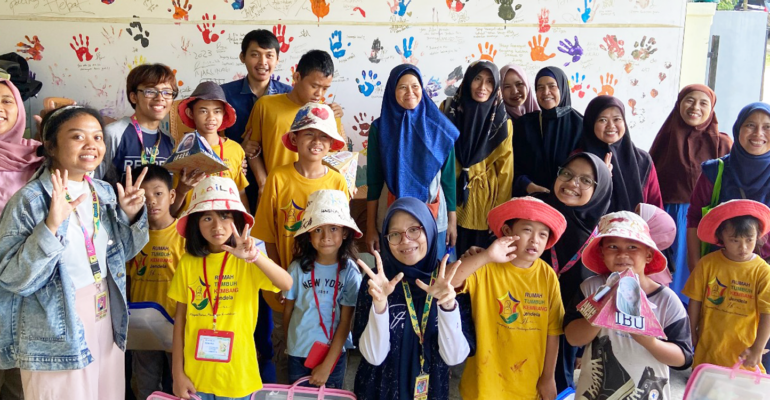
IPB University students successfully completed the Community Service Student Creativity Program (PKM PM) with the theme ‘Special Safe Space’ which took place from 19 May to 7 July 2024.
The program was led by Azzahra Putrione Adiva, a student of the Department of Family and Consumer Sciences, with members Jenita Tiodora Carolina Simbolon, Sheren Zulfa Shavira, M Omar Said, and Nur Hidayatus Zahro, under the guidance of Dr. Melly Latifah. This activity is in partnership with Yayasan Jendela Ibu located in Purimas Regency, Bitung Sari, Ciawi District, Bogor Regency, West Java.
The Special Safe Space program aimed to support 16 children with developmental disabilities such as deafness, autism, down syndrome, and cerebral palsy, along with their parents and volunteers at Yayasan Jendela Ibu.
The activity started with a campaign titled ‘Sex Education with Inclusion’. In this activity, parents and children made posters with their own decorations that voiced the importance of sex education for a safe life for children.
Azzahra said, in outline, this activity consisted of five main programs. First, First Space: All Around You. It consists of Me and Myself and My Family programs. Using Photofam Pyramid and My Name Bracelet media, children are taught to get to know themselves by making bracelets with their names and recognizing family members through photos.
“This activity aims to strengthen family relationships by introducing family members through photos and teaching basic sign language for deaf children to call parents at home,” she said.
Second Space: Self Harmony with Body’s Puzzle program. Children learn to recognize their body members through body puzzles. In addition, children also learn to colour the boundaries of the limbs using two colours, green and red through the Body’s Boundaries program. This program teaches the parts of the body that can and cannot be seen or touched by others.
“Third, Third Space: Stage of Boundaries. Children are taught about body parts that must be covered through a simulation of wearing clothes with barbie dolls and a simulation of sewing clothes for dolls. This program is named My Public Parts and My Private Parts,” explained Azzahra.
For Fourth Space: Self Hygiene, PKM PM from IPB University students use bath cards so that children can maintain personal hygiene to avoid disease.
Fifth Space: Feelings and Defenses. This program is conducted through a storytelling method with hand puppets in ‘Cerita si Jeni’. Children are taught the ‘NO-GO-TELL’ method as self-policing from strangers around them.
“This program ended with appreciation for partners and targets, as well as an outing on the campus of IPB University. Through intense cooperation and involvement of Yayasan Jendela Ibu volunteers, this program is expected to continue at Yayasan Jendela Ibu and be adopted by the wider community,” said Azzahra.
With the end of this activity, she hopes that more parties will care and support children with disabilities to get equal rights and opportunities in various aspects of life. (*/Rz) (IAAS/IAN)