
Professor Chair Holder of IPB: If Not Managed Properly, In 2045 Indonesia will experience food shortage
The current world population of 7.3 billion is expected to reach 8.5 billion by 2030, 9.7 billion in 2050 and 11.2 billion in 2100, according to a new UN DESA report. Indonesia's current population growth rate is around 1.97 percent. Java is one of the world's most densely populated areas in Indonesia. The island averages more than 2,600 persons per square mile (1,000 per square km) and has the majority of Indonesia's population on only 7 percent of the total land area of the republic. The islands of Java and Bali account for only 7 percent of Indonesia's total land area but 60 percent of the population. This large amount certainly requires settlement and infrastructure. The rate of conversion of national rice fields reaches 96 thousand hectares per year.
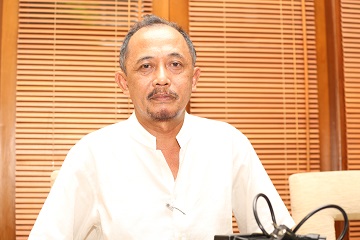
This statement was stated by Professor Chair Holder of the Faculty of Agriculture, of Bogor Agricultural University (FAPERTA IPB), Prof. Dr. Ir. Widiatmaka, DAA, in his pers conference prior his scientific oration at IPB Campus, Baranangsiang, Bogor, on 19 April 2018. According to him, there are 8.1 million hectares of paddy fields in Java. However, due to the conversion, the areas are estimated to be 5.1 million hectares by 2045.
"Domestic food production is highly dependent on Java because Java is the most fertile land. Java has a long history of settlement, and is characterized by high population densities and an intensive, highly productive agricultural system. The rice paddy system, which has been in place for many years, is located in the high potential areas of relatively fertile soils. This dependence on Java is very dangerous. If not managed properly, in 2045 Indonesia will experience food shortage, "he said.
According to the Professor who is land planning expert, most rice production takes place on the island of Java under irrigation. Rice production is heavily concentrated on the islands of Java and Sumatra; nearly 60% of total production emanates from Java alone. Rice is cultivated in both lowlands and uplands throughout Indonesia, with the upland crop typically being rainfed and receiving only low amounts of fertilizer.
Prof. Widi said that land use planning for Indonesia is really necessary. Sustainable use of the soil is a form of land management which retains the natural fertility of the soil and allows for the production of food and fiber supplies and renewable natural resources on a long-term basis. It implies that the natural environment should be treated and managed in such a way that the cycles and energy fluxes among the soil, bodies of water and atmosphere are considered, preserved or restored. Inventory, mapping and land evaluation are needed to explain the condition of land resources.
"Land evaluation has been implemented by Indonesia since 1950s. Almost all agricultural mapping data were issued by many parties, but sometimes the data are different. The government has not prioritized this. The mapping process were carried out but the available data are not used optimally," he said.
Evaluation of emerging market lands in Indonesia is dominated by application-based activities of existing land suitability criteria. But improving economic fundamentals and attractive valuations are now providing a rare window of opportunity for investors to make allocations to emerging markets, which can boost long-term portfolio performance and diversification. It is still necessary to develop land suitability criteria that reflect actual productivity.
In the last 15 years, IPB has contributed methodologies for mapping and land evaluation, including the methodology for the compilation of validated land suitability criteria, a plural-based land suitability methodology that takes into account land and socio-economic aspects and methodology of environmental carrying capacity based on land capability.
IPB also contributed to solve problems and develop aspects such as permanent land suitability parameters, integration of land suitability in spatial model, prediction of food sufficiency based on dynamic system based on land suitability, improvement of land use sustainability, integrated land suitability and description of condition of disaster prone area.
"For countries with the highest vulnerability such as Indonesia, land evaluation can be helpful to predict the disaster vulnerability," he said. (Wied)

