
IPB University Gets a Visit from the Heads of the Asia Hub Consortium, Michigan State University
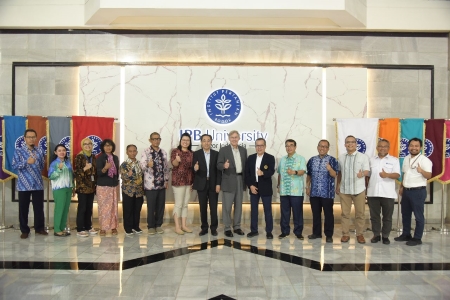
Michigan State University delegation visited IPB University. The visit was carried out in the framework of joining IPB University to become a member of the Asia Hub consortium spearheaded by Michigan State University. The delegation was received in the Chancellor's Meeting Room, Dramaga Campus of IPB (26/6).
A number of delegations who visited were Dr. Jiaguo Qi, Director of Asia Hub, Dr. Isabella Tirtowalujo; Associate Director of Asia Hub; and Dr Steve Pueppke, Asia Hub Senior Scientist (Emeritus Professor of Plant, Soil and Microbial Science). The delegation was received by the Deputy Chancellor for Global Connectivity, Cooperation and Alumni, Prof Iskandar Z Siregar; Deputy Chancellor for Research, Innovation and Agromaritime Development, Prof. Ernan Rustiadi; Assistant Director of International Program Services, Directorate of Global Connectivity, Dr-ing Azis Boing Sitanggang, deans and heads of research centers at IPB University.
“Welcome to the Michigan State University delegation. Previously IPB University had received a visit and signed a collaboration with Nanjing University China which was the initiator partner with Michigan State University in forming the Asia hub consortium," said Prof Iskandar. During this visit, he suggested visiting the Agribusiness Technology Park (ATP) as well as IPB University's Science Techno Park (STP) on the Taman Kencana Campus.
Meanwhile, Dr. Jiaguo Qi, Director of Asia Hub explained, the Asia Hub consortium was established in 2017 based on an agreement between Nanjing University and Michigan University. The consortium of 14 research institutes in Asia aims to become an international platform to promote and facilitate collaboration in research and education.
“The Asia Hub Consortium also aims to build strong international partnerships, connect like-minded regional and international institutions and networks and generate knowledge and solutions to address local and global problems. In addition, through this consortium, we will reorganize international research and education partnerships in Asia through a network of institutions with shared vision, innovation and responsibility to solve problems and create opportunities," explained Dr. Jiaguo during his presentation.
From a scientific point of view, Dr Steve Pueppke, Asia Hub Senior Scientist (Emeritus Professor of Plant, Soil and Microbial Science) explained why it is important for scientists to join the Asia Hub consortium. Each scientist will see a problem from his scientific point of view, so according to him there is no single area of scientific expertise that can provide all the answers to the most important issues faced by society.
“Besides, basic expertise is necessary but not sufficient to solve complex social problems. We need a balance between curiosity-driven science designed to solve the world's problems,” he added.
He further said that higher education must equip scientists to push the boundaries of the comfort zone based on their scientific discipline. "Scientists need to do a better job of communicating and being able to influence decision makers," he said. (dh/Rz) (IAAS/AMR)

