
IPB University Lecturers Develop Eco Printing and Zero Waste Technology for Natural Silkworms
The rapid development of the textile industry in Indonesia has indeed become the mainstay of the national economy, but the impact of this industry in the form of environmental pollution is also getting bigger.
Therefore Dr Yuni Cahya Endrawati who is a natural silk expert at IPB University said, "One of the focuses of research and development of the Laboratory of Non-Ruminants and Expected Animals of the Department of Animal Production and Technology (IPTP) of the Faculty of Animal Science is to develop commodities that support the national textile industry. Namely in the form of natural fiber, both produced from mulberry and non-mulberry silkworms based on Zero Waste Technology."
In her explanation, research resulting from cross-disciplinary collaboration from the Breeding and Genetics Division of IPB University as well as from the National Research and Innovation Agency (BRIN), produces superior quality silk thread.
"This thread is produced from superior non-mulberry silkworm strains of Samia Cynthia Ricini which can be reared with 100 percent feed using cassava leaves and marginal areas that are hot and dry," said Dr Yuni.
She added, currently the development of natural silk fiber is very much needed and will certainly support the national economy. Through the development of natural silk, this plays a very important role in reducing Indonesia's dependence on imports of silk thread, which are currently very large.
Dr Yuni Cahya is very optimistic that in the future Indonesia will be able to gradually reduce its dependence on imported silk thread. This is because Indonesia is an ideal region for developing the non-mulberry silkworm species Samia Cyntia Ricini whose feed is based on cassava leaves and castor oil leaves, so that this type of silkworm can be widely developed.
“Our research group is currently not only focusing on developing superior strains but also developing various by-product processing technologies that have added value. Such as special biscuits for toddlers to prevent stunting whose protein is based on silk pupa and also pupa flour as a feed supplement for fish and livestock feed," said Dr. Yuni.
She added, the development of natural silk fiber technology of the type Samia cyntia ricini which is long and shiny is to increase the selling value of silk thread. "This is very important, we already have the technology," she added.
Dr Yuni and her team have also implemented the zero waste concept in developing this natural silk cultivation. They developed a fertilizer processing technology from leftover feed, manure and silkworm urine.
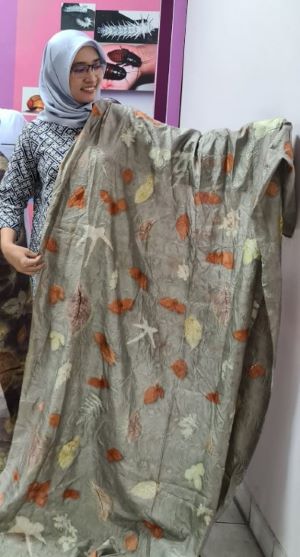
"Besides that, we are also developing eco-printing techniques using natural ingredients from various plants and other materials for dyeing silk fabrics that are environmentally friendly," said Dr. Yuni.
According to her, with this eco printing technique the research team is trying to make the textile industry environmentally friendly. This can also stimulate the national economy because the trend of demand for textile products from silk is increasing. In addition, the products are very exotic and demanded by the fashion industry.
Dr Yuni hopes that what has been developed so far can attract the interest of the younger generation in opening new businesses that are highly prospective and environmentally friendly.
"We have provided knowledge to students from an early age regarding natural silk cultivation techniques based on Zero Waste Technology. Later after graduation, they can develop entrepreneurs who are unique and highly competitive and environmentally friendly," concluded Dr Yuni Cahya Endrawati. (*/Zul) (IAAS/YMK)

