IPB University Hosted Indonesia–U.S.A.’s Research Collaborations Enhancement Workshop
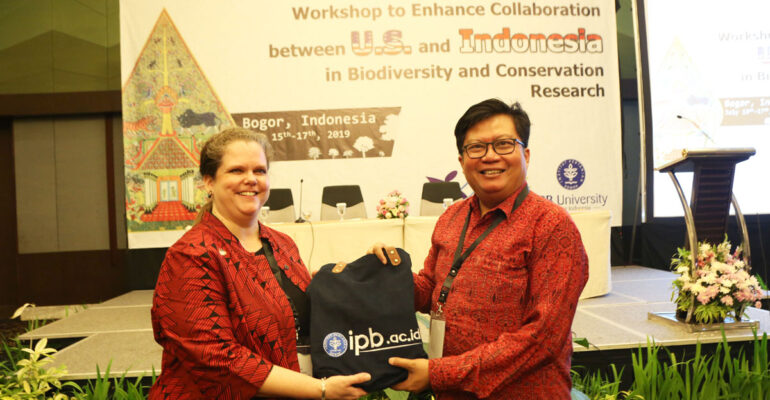
Beyond the inherent value of life on earth, we all depend on biodiversity for our own well-being. Diverse and healthy ecosystems are the basis of many livelihoods, they provide clean air and water, offer recreational and tourism opportunities, and are a buffer to natural disasters. Biodiversity is also the basis for our food, much of the world’s medicine and many of the products we rely on. With increasing global threats to the survival and health of the world’s biota, it is crucial to the environmental and economic health of the world to record, understand, and conserve biodiversity. Indonesia, home to approximately 1.2% of global landmass, accounts for a disproportionate amount of global biodiversity (e.g. ca.10% of the world’s remaining forests). Additionally, Indonesia is home to two of the word’s biodiversity hotspots, and it is experiencing rapid rates of deforestation that threaten its unique and valuable ecosystems. The United States and Indonesia are home to many researchers who are active in biodiversity science and related fields, and developing tools that can help address pressing biodiversity research and conservation needs. Nonetheless, scientific collaboration across disciplines of biodiversity science between the two countries is limited. Facilitating successful and robust international research partnerships between Indonesian and US biodiversity scientists will allow for enhanced collaborative study that can help find effective approaches for conservation. The “Workshop on Enhancing Collaboration Between the US & Indonesia in Biodiversity & Conservation Research” is included to many efforts by researchers from Indonesia-U.S.A. to reinforce their research engagements. The workshop was held on July 16th-18th, 2019 in IPB International Convention Center, Bogor and organized by IPB University, Ministry of Research, Technology and Higher Education of Republic of Indonesia (Ristekdikti) and U.S.A. National Science Foundation (NSF). The goal of this workshop was to establish productive international research partnerships allowing for collaborative and comprehensive study of ecosystems and biodiversity encompassed in a global context and facilitate international exchange and critical training of students, leading to more successful approaches for addressing global problems. Vice Rector for Cooperation and Information Systems of IPB University—Prof. Dodik Nurrochmat stated IPB University’s positioning as one of the tertiary institutions who are the most active in conducting biodiversity related research and establishing collaborations with vast number of foreign researchers. This workshop was expected to advance the existing and potential projects’ quality, particularly on ability of taxonomists and technological progresses, by involving top tier Indonesian and American researchers altogether—whilst at the same time raising the number of joint projects. The resulting discussions are expected to address the challenges faced by the two parties on biodiversity and conservation. Immense potency of biodiversity research in Indonesia is yet to be explored to its best extent—as the biodiversity itself is extensive, ranging from the deep sea to the top of the mountain. The partnerships will make it possible for scientists from various yet complimenting backgrounds to collaborate and ultimately lead to more effective solutions to the global challenges. The Director of Research and Community Service of Ristekdikti—Prof. Dr. Ocky Karnaradjasa on his remarks denoted how the biodiversity has become prioritized research specification for Ristekdikti itself. Over the past five years, collaborative works with American researchers have been thriving. It is also hoped that this opportunity would promote mobilities between Indonesian and American researchers. Meanwhile, U.S.A. Deputy Chief of Mission—Heather Variava declared that the U.S. Embassy to Indonesia and American government are sincerely proud to partner with the Indonesian counterparts and looking forward to the fruitful research together to come in the future. Researchers and counterparts from total 16 Indonesian and 22 American universities and institutes were present, namely IPB University, Bandung Institute of Technology, Gadjah Mada University, University of Indonesia, University of North Sumatera, Hasanuddin University, University of Diponegoro, Tadulako University, University of Mataram, University of Halu Oleo, University of Papua, University of Syiah Kuala, Indonesian Institute of Sciences (LIPI), Indonesian National Institute of Aeronautics and Space (LAPAN), Forestry and Environmental Research Development and Innovation Agency of the Government of Indonesia (FOERDIA), Indonesian Young Scientists Academy (ALMI), Harvard University, Yale University, Cornell University, Texas A&M, Dartmouth University, University of La Verne, Middle Tennessee State University, Kansas State University, New Mexico State University, University of Georgia, San Diego State University, University of Hawaii, Utah State University, Northwestern University, Morton Arboretum, SUNY Syracuse, Chicago Botanic Garden, Denver Botanical Garden, Carnegie Museum, Evergreen State College, Zoo Community and American Museum of Natural History.