IPB Researchers Performed Fish Starvation to Avoid Stress During Transport
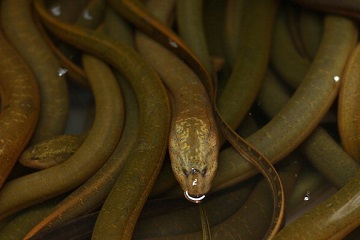
Fish starvation before the live transportation activity aims to reduce the metabolic rate, so that the water quality of transportation is more stable. In addition, it is expected to help the stress recovery from fishing and can prevent fish deaths during transport. One of the efforts to cope with stress is by increasing the salinity of aqueous media for fish starving, which is expected to suppress eel stress and recover the physiological condition of eel before being transported.
The research team consisted of Yani Hadiroseyani, Sukenda, Enang Harris Surawidjaja and Nur Bambang Priyo Utomo from the Department of Aquaculture, Faculty of Fisheries and Marine Sciences, Bogor Agricultural University (FPIK-IPB) and Ridwan Affandi from Department of Water Resource Management FPIK-IPB conducted a research on the effect of fish starving in saline media on the physiological of eels. This study aimed to evaluate the physiological response of Monopterus albus eels starvation on different salinity levels.
"The eels used for this research was collected from Cianjur, West Java. Fish stun device was used to catch the eel at 22.00 pm to 02.00 am based on the usual procedure of eel catcher on the harvested paddy fields area. At 08.00 am on the next day, eels have been collected from five catchers, "said Yani.
The eels with size of 26.64 centimeters long with average weight of 12.57 grams were used for this experiment. The biomass (total weight) of the eels is 1 kilogram in 5 liters of water or at a density of 200 kilograms per cubic. Eel starvation was done on four brown plastic containers measuring 80 cm x 40 cm x 30 cm. Each filled by 5 liters of water in different salinity. The salinity was increased by adding krosok/traditional salt (NaCl) according to dosage of the treatment. Eels left to starve for three days in aqueous media with four treatment levels of salinity, i.e. zero grams per liter, three grams per liter, six grams per liter, and nine grams per liter.
The study, which was also part of Yani Hadiroseyani's dissertation, showed the physiological changes resulting from eels starvation on the saline media. The researchers found that the starvation resulted in the increased of cortisol levels. However, increased salinity can suppress the hormone levels. Sodium blood plasma levels of eel fish have increased in line with the salinity level.
Eel glucose levels geared at zero and three grams per liter salinity were statistically higher and significantly different than those in the six and nine grams of saline per liter. While, the glycogen levels of eels liver on the salinity of 0 and 3 grams per liter were statistically lower compared to those at 6 and 9 grams per liter of salinity. The three-day starvation on all salinity treatments did not result in changes in the value of the eel condition factor. Nevertheless, the eels provided the best physiological response to a three-day starvation in a 9 gram L-1 saline water medium.
"Eel starvation in aqueous media showed that eel were under stress and experienced the increase of cortisol and blood glucose level. But stress can be reduced by increasing water salinity, which resulted in the decreased of osmotic gradient and the improvement of the physiological status of eels during starving."
The best physiological response was obtained at the third day of eel starvation on the aqueous media with 9 grams per liter of salinity, which has the lowest osmotic gradient value (0.090 mOsmol kg-1), the highest blood plasma sodium content (84.20 millimol L-1, the lowest glucose (21.52 mg dL-1) compared to early starvation with lower salinity, "he said. (TK)