Succession from IPB’s Transitional Audit Board of 2012-2013 to IPB’s Audit Committee of 2015-2019 Friday, March 13, 2015
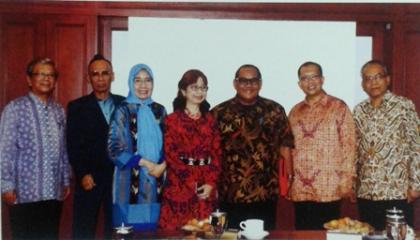
Plenary Session of the Board of Trustees of Bogor Agricultural University (MWA IPB) with the agenda of the succession from the Audit Board (DA) to the Audit Committee (AC) of was held in Jakarta, 27/2. The meeting was opened and chaired by Dr. Ahmad Mukhlis Yusuf as Vice Chairman of MWA-IPB.
It began with the delivery of the MWA Decree No. 07 / MWA-IPB / 2015 on Appointment of IPB’s Audit Committee Members for the period of 2015-2019 by Vice Chairman of MWA-IPB, Dr. Ahmad Mukhlis Yusuf. The Audit Board’s members in the transition period of 2012-2013 were Prof. Dr Azyumardi Azra, Ir. Setiadi Djohar, MBA, DBA, Prof. Dr Karhi Nisjar Sarjudin, Prof. Dr M. Enoch Markum, and Dr. Dewi Hanggraeni, SE, MBA. Meanwhile, the IPB Audit Committee’s members for the period of 2015-2019 are Dr. Dewi Hanggraeni, Ir. Karyaningsih, Drs. Rosjidi, Ak, CFE, and Ir. Setiadi Djohar, MBA, DBA. IPB’s Audit Committee is chaired by one of the MWA members, Dr. Sugiharto, SE, MBA.
Dr Sugiharto, SE, MBA, in his capacity as Chairman of the Audit Committee, said that the atmosphere of friendship in the meeting is expected to positively influence the service of the Audit Committee for the next five years. In the past, the Audit Board was outside MWA, but now and it is the first in history that the Audit Committee is in MWA. Audit Committee consists of those who are highly experienced and skilled in various fields including forensic investigations, general audit, business unit management, risk management, risk-based auditing, and financial management / accounting. Their experience and expertise are expected to be shared with IPB. With the new statute, IPB is expected to be a role model for other campuses; therefore, governance practices in the process of checks and
balances will be put into effect again. The Audit Committee’s task in the new paradigm is not to find faults. It is a partner, a consultant, and a problem solver as well as helps the auditee. It does not make investigation, but reviews the results of a study made by the Internal Audit Office (KAI) and the Public Accounting Firm (KAP). It will focus on strategic issues. It is a partner of Rector in achieving success and progress of IPB.
On behalf of IPB’s leaders, Prof. Dr. Herry Suhardiyanto, as Rector, expressed thanks and appreciation to the Leaders and Members of IPB’s Audit Board for having helped with making improvements in financial and asset management, and others. Congratulation to the members of IPB’s Audit Committee who will carry out the task, and it is expected that they are able to maintain better implementation of governance in IPB.
IPB’s Strategic Plan of 2014-2018 should be immediately completed to be more progressive than before, given that the transformation into PTNBH (State University as Legal Entity) is a very important policy, with a lot of challenges. The birth of Law No. 12 of 2012 on Higher Education is the basis for IPB to continue the transformation, and this is related to the speed issue. When the legal aspect is not clear, then the possibility of the emerging problems is greater, but with the Law No. 12/2012 and the Government Regulation No. 66/2013 on the Statute of IPB, the legal aspects become more certain. Based on Government Regulation No. 66/2016, Audit Committee (AC) is an apparatus of MWA (Board of Trustees), which independently has the function to evaluate the results of the internal and external audit
o
f IPB administration for and on behalf of MWA. Thus, there is no separation between MWA and Audit Board. With the Audit Committee already established, IPB is expected to move forward more rapidly without taking wrong steps based on the risk-based audit whose principles we all understand.
Rector hopes that the policy to be made is based on evidence and correct data. In this way, the evidence-based policy, evidence-based decision making can be enforced in IPB. As
gratitude and appreciation, Rector, witnessed by MWA-IPB leaders, Dr. Ahmad Mukhlis Yusuf, and Prof. Rizal Sjarief Sjaiful Nazli, then gave IPB souvenirs to the Members of IPB’s Audit Board represented by Prof. M. Enoch Markum and Dr. Dewi Hanggraeni, SE, MBA. Plenary Session of MWA IPB was officially closed by Dr. Ahmad Mukhlis Yusuf. (Mtd)