
The potential of the Indonesian Oil Palm Can Still Be Improved Tuesday, November 18, 2014
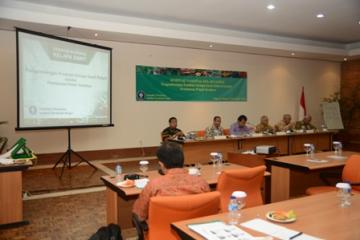
The very important commodities of Indonesian people’s plantation are rubber, oil palm, coconut and cocoa. Of these, oil palm plantations are still with a wide range of issues: the many overlapping spatial use, the many oil palm plantations on forest areas and on peat land, agrarian issues (land ownership), the control of foreign capital, the proportion of estate and the people’s plantations, and others.
Given such background, Faculty of Agriculture, Bogor Agricultural University (IPB) held a National Seminar on Oil Palm, Development of People’s Oil Palm Production through the Development of Self-Organizing Farmers, in Papyrus Hotel Bogor (15/11).
Dean of the Faculty of Agriculture, Prof.Dr.Ir. Ernan Rustiadi said the Indonesian politics today is giving a big attention to the development of people’s oil palm plantations. Many would like to reduce the share of oil domination by foreigners or large corporations.
"Speaking of oil, it is difficult for us to close our eyes on the political issues of the global trade. Many countries are threatened and to compete with the increasingly competitive of our palm oil. Our production reaches 3.5 million tons per hectare per year. No other vegetable oils can match. Therefore, many attempts try to restrict the entry of our exports of oil products," he said while giving a speech.
"The farming system of oil palm is the largest in our agricultural land occupation," he added. Our palm has occupied 10 million hectares, far beyond our rice area that continues to decrease, i.e., under 8 million hectares resulting from a long balancing process.
"Another problem is technology. The palm potential is still huge. Currently oil production is still below what can actually be produced. In addition, untapped biomass from palm waste is still remarkably potential. It’s a source of new growth which we imagine will be very large. Thus, it needs special attention to the importance of the empowerment of self-financing oil palm farmers," he explained.
Meanwhile, according to Joko Supriono Secretary General of the Indonesian Oil Palm Association (GAPKI), companies buy fresh fruit bunches (FFB) from the factory, but with transportation cost of 200 rupiahs per kilo farmers only enjoy half price due to the transport cost and the middlemen who can be of three levels. "There are those called galas people (middleman of level one), collectors of level 2 and level 3 who use big truck of 30 tons covering the distance of 100-200 kilometers. You can imagine the profit margin for the farmers depleting there although 43% of the total area of oil palm is owned by private farmers. If the harvest from the farmers were not bought by the company, what would happen? In fact, one farmer ever says that if the company does not want to buy it, they will burn the factory," he said.
One disadvantage for the farmers is no bank financing their self-financing plantations, so there is no plantation revitalization. According to him, if the company wants to help, then it is in the context of CSR. However, with no certainty in marketing, this will not be successful. (Mtd)

