Marking Five Windu of Integrated Pest Management, IPB University Calls for the Revitalization of IPM and the Regeneration of Farmers
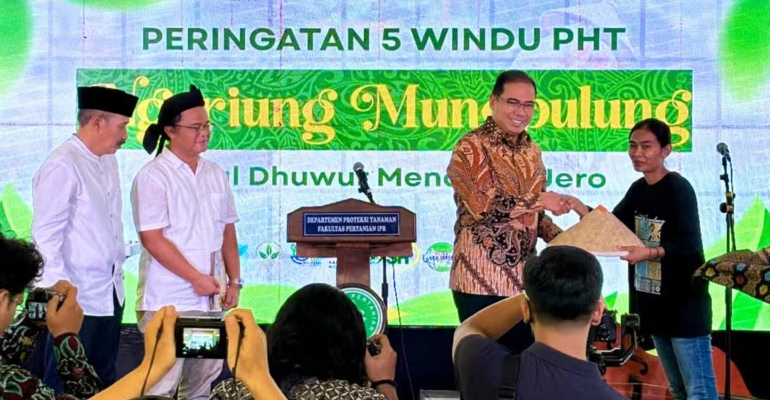
Participants in the symposium marking five windu of Integrated Pest Management (PHT) called for the revitalization of PHT and the regeneration of farmers, as well as the strengthening of PHT networks to be passed on to younger generations. They also agreed that PHT is a strategy, not merely a cultivation technique.
The symposium, themed “Ngariung Mungpulung: Mikul Dhuwur, Mendhem Jero,” was organized by IPB University through the Plant Protection Student Association (Himasita), the Department of Plant Protection, and the Faculty of Agriculture (Faperta).
There were 120 participants, including farmer alumni of the PHT Field School (SLPHT), field instructors, academics, representatives from government ministries, the private sector, agricultural advocates, civil society organizations, and students from West Java, Central Java, Yogyakarta Special Region, East Java, East Nusa Tenggara, and Jakarta.
Continuing the IPM Movement
IPB University Faperta Professor, Hermanu Triwidodo, stated that this event brought together PHT practitioners to reconnect and reflect on the journey of PHT. Additionally, it served as a tribute to President Soekarno, who laid the foundation for food sovereignty, and President Soeharto, who initiated the integrated pest management policy.
“By reflecting on the journey of PHT and the contributions of these two figures, farmers need to continue this movement and create their own PHT history. This movement must continue to be championed through concrete actions in the field,” he said during a seminar at the IPB Dramaga Campus (10/24–25).
Universities Must Learn from Farmers
The Rector of IPB University, Dr Alim Setiawan Slamet, noted that farmers who visit IPB University are, in a sense, returning home together. According to him, PHT teaches us that food security cannot be achieved merely by ensuring sufficient inputs, but rather through the knowledge and wisdom held by farmers themselves.
He agreed with the roundtable’s recommendations: that the PHT network needs to be strengthened and passed on to younger generations, while farmers’ observations of agroecosystems need to be integrated with digital intelligence. University curricula, as well as IPB University programs such as One Village One CEO (OVOC), Faculty Return to the Village, and the Student Real Work Lecture (KKN), are expected to integrate PHT.
“The 40 years of PHT experience lie in the farmers’ fields. IPB is here to listen and use this as a basis for strengthening agricultural guidance, research, and education in collaboration with farmers,” he said.
It’s Not Just About Technology
Two Emeritus Professors from the Department of Plant Protection at IPB University, Prof Syafrida Manuwoto and Prof Aunu Rauf, emphasized that agriculture is not just about technology.
“For IPB, PHT is not merely a program. For the IPB community, it is a mandate from President Soekarno when he laid the cornerstone of IPB,” Prof Syafrida asserted.
Prof Aunu Rauf added that the solution to agriculture’s “stagnation” does not end with technology. If there are policies that view agriculture solely as a matter of technology and disregard IPM, all parties must have the courage to correct them. “Food production is not just about technology, but also about farmers’ knowledge and skills. That is what IPM is all about,” he explained. (dh) (IAAS/KQA)