Climate Related Losses Reach Rp544 Trillion, IPB University’s P4W and Chiba University Push for Strengthened Agricultural Insurance
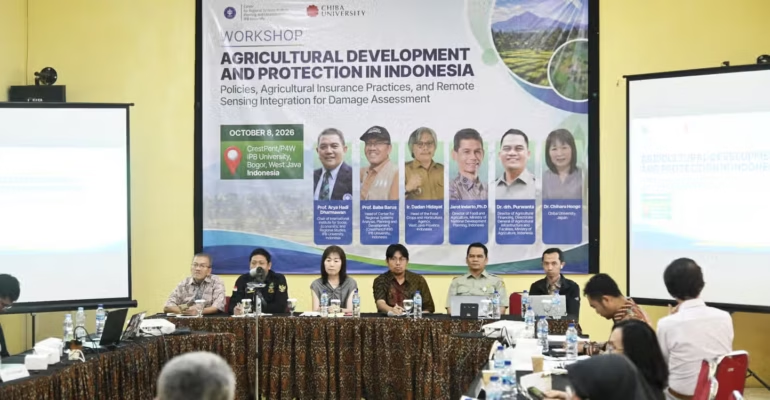
The National Development Planning Agency (Bappenas) estimates that losses resulting from the impacts of climate change amount to approximately Rp544 trillion. This has the potential to significantly affect the agricultural sector. Amid these risks, agricultural insurance is expected to provide a solution, but its implementation on the ground still faces many obstacles.
These issues were discussed by the Research Center and Planning for Regional Development (P4W), the International Research Institute for Social, Economics, and Regional Studies (LRI PSEK) at IPB University, together with Chiba University, during a workshop titled “Agricultural Development and Protection in Indonesia: Policies, Agricultural Insurance Practices, and the Integration of Remote Sensing for Damage Assessment” in Bogor on Tuesday (10/8). The event was attended by practitioners, academics, government officials, non governmental organizations (NGOs), representatives from the banking sector, and agricultural insurance companies.
Regulations Exist, but Implementation Is Stalled
Agricultural protection already has a legal foundation, including Law No. 22 of 2019 on the Sustainable Agricultural Production System and Law No 19 of 2013 on the Protection and Empowerment of Farmers. These regulations cover compensation for crop failures, early warning systems, addressing the impacts of climate change, and agricultural insurance.
However, the challenge lies in translating these regulations into practice. Research conducted by P4W IPB University across 19 provinces revealed differences in conditions and needs across regions. Obstacles include limited infrastructure, technological support, and data collection systems, as well as farmers’ reluctance to participate in insurance programs.
“We believe that the development of agricultural insurance requires a combination of technology, human resources, institutional support, accurate data, and policies tailored to on-the-ground conditions. Therefore, outreach, education, mentoring, and training for trainers need to be expanded,” said Prof Baba Barus, Chief of P4W IPB University.
This research is the result of the implementation of SATREPS (Science and Technology Research Partnership for Sustainable Development) training, a research collaboration between the Japanese government and developing countries, including Indonesia.
Integration of Credit and Insurance
Nur Afianto, a representative from Bappenas, emphasized that agricultural protection and insurance should not merely be reactive measures taken after a disaster but must instead be part of planned and sustainable programs.
“The government is also promoting the integration of credit and insurance so that farmers who receive loans can still meet their obligations in the event of crop failure. Modernization, digitization, data strengthening, and farmer empowerment must be part of an interconnected system,” he said.
According to Nur, insurance should not be viewed merely as a compensation mechanism, and farmer protection must be balanced with the sustainability of insurance companies’ operations.
Satellite Technology as a Tool, Not an End in Itself
To address data challenges, remote sensing is seen as a potential solution. Dr Chiharu Hongo of Chiba University said that integrating remote sensing and geographic information systems (GIS) has the potential to improve the efficiency and accuracy of crop damage assessments for agricultural insurance.
However, he added, insurance claim calculations could be unfair if crop damage ratios are calculated on a regional basis. Assessments on a plot-by-plot basis would be more precise but require extensive land polygon data and significant manpower for maintenance.
The Chairman of LRI PSEK at IPB University, Prof Arya Hadi Darmawan, noted that satellite data and geospatial analysis can support more accurate damage verification and cover a wider area. However, technology should be viewed as a tool to strengthen the protection system, not as an end in itself.
A Scheme Tailored to Farmers’ Needs
Prof Arya hopes the workshop will foster a shared understanding to strengthen agricultural insurance policies and institutions from the national to the village level.
“Agricultural insurance schemes need to be developed to provide protection that is more accurate, credible, and tailored to farmers’ needs,” he said.
Through collaboration among the government, farmers, academics, NGOs, the private sector, banks, and insurance companies, the agricultural protection system is expected to become more effective, transparent, and accessible. The workshop also featured the Director of Agricultural Financing at the Ministry of Agriculture, Dr drh Purwanta. (*/Rz) (IAAS/KQA)