To Achieve Economic Self Reliance for Islamic Boarding Schools in Jombang, IPB University Strengthens the Upstream-Downstream Rice Ecosystem
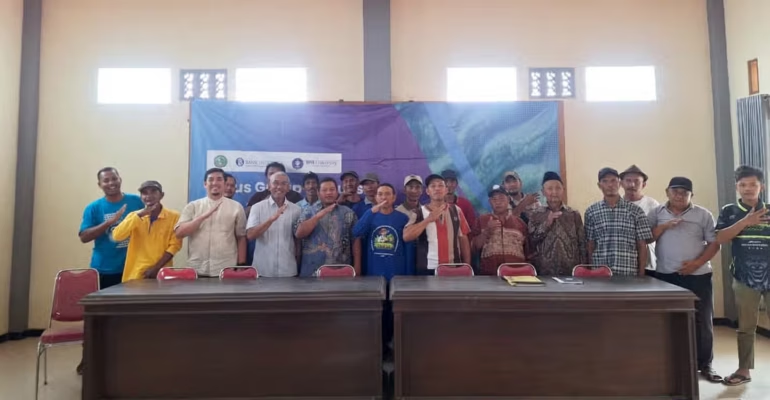
IPB University, through the Center for Islamic Business and Economic Studies (CIBEST), is ensuring a guaranteed supply of high-yield rice seed varieties IPB 13S and IPB 15S for farmers in Sugihwaras Village, Jombang, East Java.
This initiative is being realized through a partnership between the Fathul Ulum Islamic Boarding School, the Modern Creative Industry Producers Cooperative, the Sugihwaras Village Farmers’ Group Association (Gapoktan), and PT Botani Seed.
In addition to a guaranteed seed supply, farmers will also receive regular technical guidance on cultivation, support for strengthening the producers’ cooperative, and assistance with preparing facilities for processing the harvest.
Cooperation between the cooperative and the farmers’ association will also be expanded through rice distribution to retail networks, the supply of unhusked rice to the Business Unit of the Sunan Drajat Islamic Boarding School in Lamongan, and the provision of non subsidized fertilizers and liquid fertilizers.
IPB 3S and IPB 15S are high yielding rice varieties developed by IPB University with a potential yield of up to 9 metric tons per hectare. These varieties are also rich in zinc to support community nutritional needs, particularly in preventing stunting.
During the Institutional Governance Training (10/10), the Secretary of CIBEST at IPB University, Rahmat Yanuar, SP, MSi, emphasized the importance of strengthening cooperative institutions as the ideal framework for farmers.
“Through a structured institutional framework, cooperatives not only act as guarantors of market certainty and liaisons with business partners, but are also able to mitigate risks in the field, reduce operational costs, and facilitate access to capital as well as negotiate the best prices before the planting season begins,” he said.
He emphasized, “Cooperatives are jointly owned by farmers, so transparency and open information are the main foundations for sustainably improving members’ productivity and well being.”
One of the farmer representatives, Bahruddin, welcomed the collaboration and support provided with optimism. “We farmers wholeheartedly welcome the plan to plant the IPB 13S and IPB 15S varieties. In addition to their high yield potential, the availability of high quality seeds coupled with technical assistance and guaranteed buyers through the cooperative network gives us peace of mind and price certainty.”
“We hope that this kind of support and partnership will continue so that the cooperative institutions established can become truly self reliant and capable of raising the standard of living for farmers in Sugihwaras Village,” he said.
This ecosystem is further strengthened by the Rice Milling Unit (RMU) in Sugihwaras Village, which is scheduled to be fully operational by the end of October 2026. The RMU is equipped with a 10-metric-ton vertical dryer provided through assistance from Bank Indonesia as well as a supporting electrical grid and a fleet of tractors for land cultivation.
By linking seeds, cultivation, institutions, markets, and processing, this synergy is expected to improve the welfare of local farmers in a sustainable manner while strengthening food sovereignty in Jombang Regency, East Java. (*/Rz) (IAAS/DON)