Waigeo Cuscus on a Fallen Tree, IPB University Expert: It Signals Habitat Loss for Papua’s Endemic Species
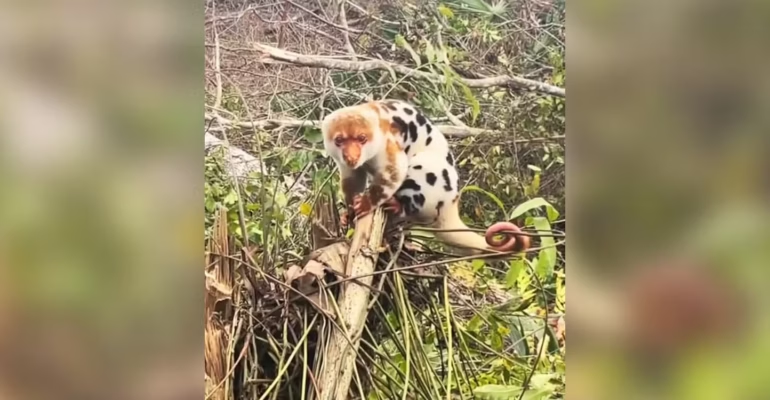
A viral video showing a Waigeo cuscus (Spilocuscus papuensis) perched on a felled tree trunk has drawn attention to the habitat conditions of West Papua’s endemic species.
Dr Abdul Haris Mustari, a lecturer in Forest Resource Conservation and Ecotourism at IPB University, believes the appearance of the cuscus on the fallen tree is a strong indication that the animal has lost its natural habitat.
Arboreal Animal
The Waigeo cuscus is a marsupial from the Phalangeridae family and is endemic to Waigeo Island in West Papua. According to Dr Mustari, this species is entirely arboreal, meaning its survival is heavily dependent on the presence of forests and trees.
“The Waigeo cuscus is a fully arboreal species. The forest is everything to this animal, it serves as its habitat, a place to forage for food and water, seek shelter, and reproduce,” said Dr Mustari.
He explained that the Waigeo cuscus can inhabit various types of forests, ranging from mangrove forests, coastal forests, lowland forests, to mountain forests. This species is also omnivorous, feeding on fruits, leaves, flowers, insects, eggs and baby birds, as well as small reptiles.
Therefore, the presence of a cuscus on a felled tree is considered an unusual occurrence. Dr Mustari noted that these animals should normally be found in the canopy of primary forests or old-growth secondary forests.
“The presence of the Waigeo cuscus atop a felled tree clearly indicates that this species has lost the habitat it has inhabited for generations,” he said. The situation is made even more serious because the Waigeo cuscus moves relatively slowly and lives a solitary life.
On the Brink of Extinction
Furthermore, Dr Mustari noted that the loss of the forest canopy makes the cuscus more vulnerable to disturbances, deprives it of food sources and shelter, and increases the risk of capture by humans. Deforestation and forest fragmentation can cause the cuscus population to split into small, isolated groups.
“These conditions have the potential to reduce genetic diversity through inbreeding, lower birth rates, increase mortality, and ultimately drive the population toward the brink of extinction (extinction vortex),” he explained.
Dr Mustari emphasized the importance of maintaining the continuity of the canopy between trees so that cuscus can move naturally. In fragmented habitats, connecting corridors between forest areas also need to be maintained or restored.
“Deforestation and land conversion are slowly but surely driving this endemic species toward extinction. The loss of biodiversity means the loss of one of the links in the chain of life,” he concluded. (dr) (IAAS/LAN)