Rice Seed Breeding Field School: Introducing Merauke Farmers to IPB University’s High Yielding Rice Varieties
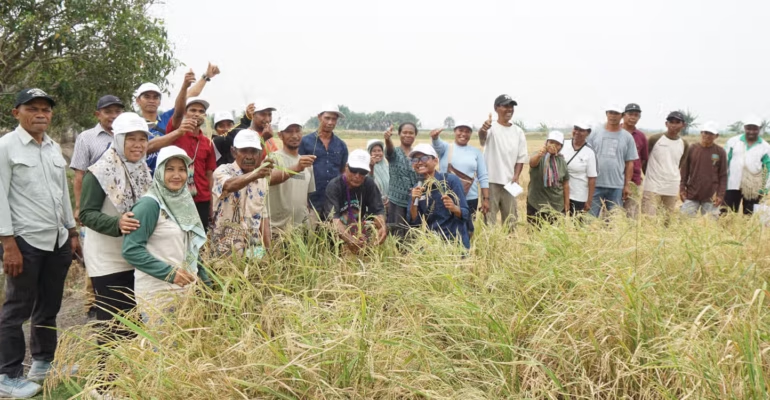
The IPB University Patriot Expedition Team (TEP), which is currently implementing a program from the Ministry of Transmigration in Tanah Miring District, Merauke Regency, South Papua, held a Field School on Rice Seed Propagation for the IPB 9G and IPB 15S varieties (10/2–3).
This activity was designed to enhance farmers’ capacity while promoting self-reliance in rice seed production in South Papua. Abbas Alibasyah, SP (Plant Seed Inspector (PBT) at the West Java Center for Supervision and Certification of Food Crop and Horticultural Seeds (BPSBTHP)) and Daniel Moya, SP (South Papua Provincial Office of Food, Agriculture, Marine Affairs, and Fisheries) served as presenters.
Hundreds of rice farmers from several villages in the Tanah Miring District participated in this event. Also in attendance were various stakeholders, including the Main Seed Center, field agricultural extension officers (PPL), and the Merauke Regency Department of Manpower and Transmigration.
Dzakwan Haqqi, a representative from IPB University’s TEP, noted that participants received a variety of training materials, ranging from procedures for certifying food crop seeds and an introduction to the IPB 9G and IPB 15S rice varieties to roguing techniques.
“The farmers conducted hands-on training in the demonstration plots to observe the IPB 9G and IPB 15S varieties. They also learned to identify and remove unsuitable plants. This training is an important part of learning roguing techniques to ensure the purity of the varieties is maintained,” he said.
One of the participants, Norbertus, noted that the Field School provided farmers with new insights into rice seed production. “This activity has greatly expanded our knowledge of rice seed production because it combines academic knowledge from the university with practical experience in the village. As a result, the knowledge gained can be directly applied to real-world conditions in the field.”
According to him, the combination of classroom learning and hands on practice in the field helps farmers understand the material more concretely. It is hoped that this knowledge will equip farmers to improve the quality of seed production in their regions.
Through this activity, TEP IPB University hopes that farmers’ capacity in seed production will continue to improve and that collaboration between farmers, extension workers, seed institutions, universities, and the government will grow stronger in supporting the availability of high quality rice seeds in South Papua. (*/Rz) (IAAS/EPK)