Do Ripe Fruits Have Higher Sugar Content? Here’s the Explanation from an IPB University Professor
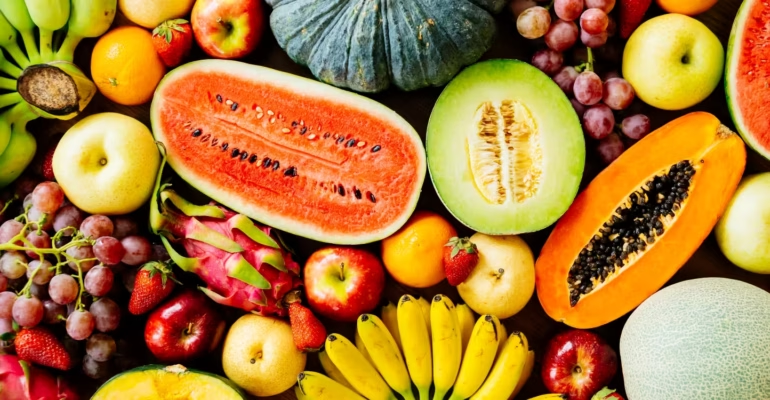
Many people choose ripe fruits because they taste sweeter. This is because ripe fruits have a higher sugar content than unripe ones.
Prof Antonius Suwanto of the Faculty of Mathematics and Natural Sciences (FMIPA) at IPB University explains that this occurs because the carbohydrates in unripe fruit are still dominated by resistant starch, which the body digests more slowly.
“During the ripening process, the complex starch inside the fruit breaks down into simple sugars, such as glucose, fructose, and sucrose. That’s why the riper the fruit, the higher its sugar content, and the sweeter it tastes,” he said on the “ Perspective program aired on IPB TV’s YouTube channel.
Nevertheless, ripe fruit still offers benefits because it is rich in vitamins and antioxidants. Therefore, the choice between consuming unripe or ripe fruit should be tailored to individual nutritional needs and health conditions.
For some types of fruit, a specific level of ripeness is actually preferred by consumers. He cited durian as an example, the skin is still hard, but the flesh is already soft, so its sugar content is relatively lower compared to fully ripe durian.
Adjust According to Your Needs
Prof Antonius said that unripe fruit can be an option for people who need to limit their sugar intake because it has a lower fructose content. Even so, the fruit still contains minerals, vitamins, and fiber that are beneficial to the body.
However, he cautioned that portion size remains a more important factor than simply choosing the fruit’s level of ripeness.
“If you eat ripe fruit but in moderate amounts, it might still be okay compared to eating a large amount of half ripe fruit,” he explained.
He added that both underripe and ripe fruit are equally beneficial for health when consumed wisely. It is more advisable to eat fruit whole so that its natural fiber content is preserved.
According to Prof Antonius, natural fiber serves as food for the good bacteria in the large intestine. These bacteria not only help maintain the immune system but also produce various compounds, including vitamins and hormones, that influence overall physical health, and even mental health.
“When consuming fruit, it’s best to eat it whole because whole fruit contains fiber. Both unripe and ripe fruit are still far better than snacking on junk food,” he concluded. (Fj) (IAAS/DAM)