IPB University Lecturer Explains Volcanic Ash from Anak Krakatau Carried by Winds Toward the Ocean
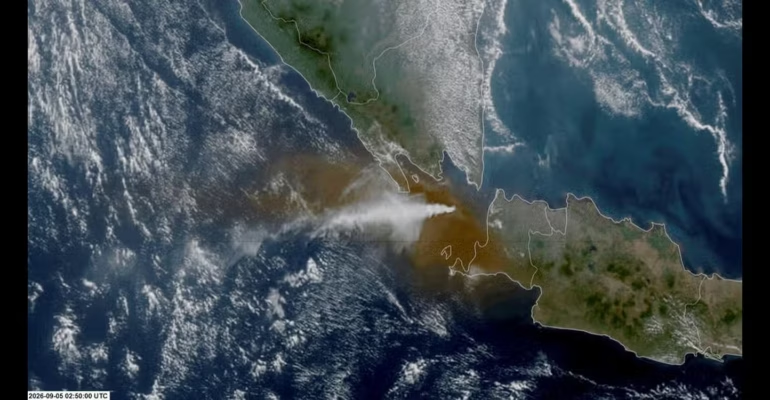
Most of the volcanic ash from the eruption of Anak Krakatau in early September 2026 moved westward toward the Indian Ocean, away from mainland Indonesia.
According to Sonni Setiawan, SSi, MSi, a lecturer in the Department of Geophysics and Meteorology at IPB University, this condition was closely related to the direction and speed of winds at the altitude where the ash was located, which can differ from wind conditions at the surface.
“The main factors are the direction and speed of the wind at the altitude where the ash is located, rather than simply the wind felt at the surface. The higher the eruption column rises, the more likely the ash is to enter different wind layers,” he explained.
This condition was reflected in information released by the Meteorology, Climatology, and Geophysical Agency (BMKG) on September 7, 2026. Volcanic ash at altitudes of up to approximately 15.000 feet was moving westward at around 15 knots. Meanwhile, at altitudes of up to 50.000 feet, the ash had been carried farther toward the Indian Ocean and away from Indonesian territory.
Vertical Wind Shear
Differences in wind direction and speed between atmospheric layers are known as vertical wind shear. This condition causes eruptive materials at different altitudes to follow different paths.
“Near the surface, winds are influenced by friction with land and vegetation, topography, differences in land and sea temperatures, as well as local winds such as sea breezes and land breezes. At higher altitudes, the influence of surface friction becomes weaker, allowing winds to become stronger and their direction to differ,” he explained.
Therefore, some of the ash may remain around the volcano, while material that reaches higher atmospheric layers can be carried farther toward the ocean.
Many Factors
The distribution of volcanic ash is influenced by the height of the eruption column, the intensity and duration of the eruption, turbulence, atmospheric stability, and rainfall. A higher eruption column allows ash to enter atmospheric layers with different wind characteristics, causing its range and direction to vary.
Changes in wind direction can also cause the ash distribution pattern to change relatively quickly. He explained that ash newly released from the crater can respond to changes in wind conditions within a matter of tens of minutes to several hours. However, ash that has already been carried by the wind does not immediately reverse direction.
“Material that has already been carried away will continue along the previous wind path, while newly released material will follow the latest wind conditions. Therefore, the ash distribution can form different patterns at different times,” he said.
To anticipate changes in the direction of ash dispersion, he noted several conditions that need to be monitored, including the vertical wind profile, the height of the eruption column, changes in upper level wind direction, local winds around the Sunda Strait, and large-scale weather systems.
On September 10, 2026, BMKG reported that volcanic ash was no longer detected in Indonesian airspace because it had moved farther toward the Indian Ocean. However, the dispersion pattern may still change if a new eruption occurs or if there are significant changes in wind direction and speed at the altitude of the ash column. (AS) (IAAS/HRD)