
Ahead of Eid al-Adha, the IPB University Alumni Association Educates the Public on Safe, Healthy, and Halal Qurbani Standards
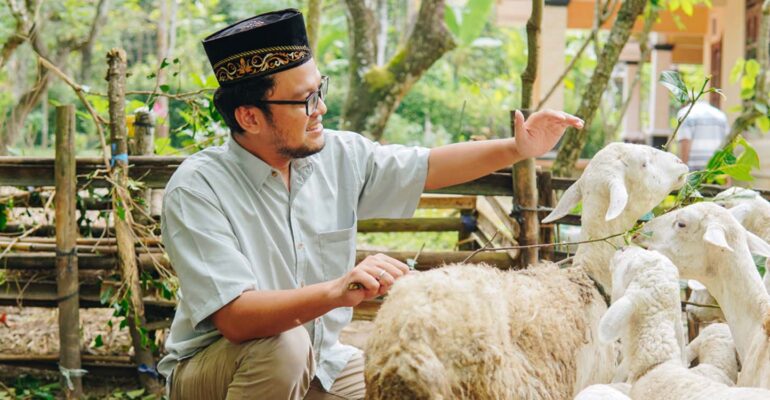
The IPB University Alumni Association (HA), in collaboration with the IPB Faculty of Animal Science Alumni Association (HANTER), held a national webinar titled “Sacrificial Slaughter Standards in Accordance with Safe, Healthy, and Halal Principles” on Friday (5/15).
Through this webinar, participants were provided with comprehensive guidelines covering the entire process from start to finish including the selection of live livestock, animal handling techniques, the slaughter process, and waste management after slaughter.
From the perspective of livestock selection, choosing the right sacrificial animals is crucial for estimating the amount of meat to be distributed. Edit Lesa Aditya, SPt, MScAgr, a lecturer in animal breeding at IPB University, explained that the accuracy of physical assessment of sacrificial animals is crucial.
“If two cows have the same weight but different body builds, the meat yield can differ by up to two percent. Choose animals with a body condition ranging from moderate to fat to ensure a sufficient meat yield,” explained Edit.
He also reminded the sacrificial animal committee not to be misled by the size of the animal’s distended abdomen. “Don’t look at the abdomen because it can be empty if the animal has been fasted; instead, look at the hindquarters and shoulders where the meat accumulates,” he added.
From a technical execution standpoint, Dr drh Supratikno, a trainer for halal slaughterers (Juleha) at the Halal Science Center (HSC) of IPB University, emphasized the application of the principle of ihsan to ensure animal welfare and the halal status of the meat.
According to him, stress mitigation in animals must be carried out through calm handling, the use of safe slaughter facilities, and the use of sharp blades. “Calm the animal, sharpen the knife, and make the process quick. The best slaughter is the quickest slaughter,” he emphasized.
He explained that the cut must be made precisely behind the Adam’s apple to sever the three main channels simultaneously and quickly. Supratikno also strictly prohibited incorrect practices commonly observed in the field. “A sharp knife reduces the animal’s pain during slaughter. Do not stab the chest, as that kills the animal not through the slaughter itself,” he concluded.
As a follow up to the program, in person training for halal slaughterers will be conducted. This ongoing initiative is expected to foster a more hygienic sacrificial ecosystem, maintain environmental order through proper management of offal waste, and ensure peace of mind for those performing the sacrifice. (MW) (IAAS/KQA)

