Students of IPB Utilized Bamboo Betung to Become Environmentally Friendly Plastic
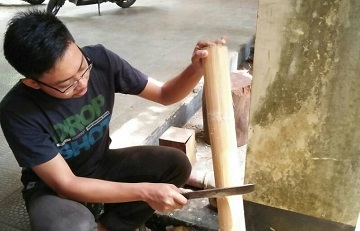
Indonesia was one of the world’s largest plastic waste generating countries. According to the research of Jambeck et al. (2015) that Indonesia was ranked the second in the country of plastic waste producers in the world with the amount of 187.2 million tons per year after China which reached 262.9 million tons per year. This was due to the use of the plastic bag by the community which was very high. The conventional plastic bag was made with the petroleum which was one of the non-renewable natural resources and the number was declining. The plastic consumption also caused various problems, especially the environmental issues, considering the plastic bag took 100 years to decompose, because it could not be deciphered quickly and naturally by the destructive microbes in the soil.
The alternative to handle that was by developing the environmentally friendly plastic products. Therefore, Ari Bima Putra, the student of Bogor Agricultural University (IPB), Chairman of Student Creativity Program, Research (PKM-P) with the team consisting of Mar’atus Solikhah, Asri Soviana Boang Manalu, and Mishbahul Khoiron Gumelar were driven to make the eco-friendly plastic products or called the bioplastic. The bioplastic was a plastic product made of easily decomposed material, called the biodegradable plastic. The advantage of the bioplastic was to reduce the amount of plastic waste which was more in number. The bioplastic was designed to facilitate the degradation process toward the enzymatic reaction of the microorganisms such as the bacteria and the fungi.
Ari said, the background of choosing this topic was to develop the bamboo-based biodegradable plastic products as non-timber forest products. Other than that, as well as a solution to reduce the use of the conventional plastic which was made from the petroleum.
One of the potentially bioplastic ingredients was the cellulose of bamboo betung (Dendrocalamus asper), because the existence of bamboo in Indonesia was quite a lot. The level of holocellulose (cellulose and hemicellulose) of bamboo betung was high enough, i.e. amounted to 83.8 percent. The high cellulose indicated the strong fiber, the whiter color, the relatively resistant to chemicals in the separation and the purification. The existence of bamboo betung in Indonesia was also quite a lot, so that it was very potential to be used as the raw materials that were environmentally friendly bioplastic.
The student of Department of Forest :Products, Faculty of Forestry explained that the stages of this study was preceded by the literature study, the preparation of tools and materials, the pulping, the cellulose insulation, the bioplastic synthesis, and termination of the test (tensile test and grave test). “Now it comes to the stage of the bioplastic synthesis. The result is, it is obtained the cellulose that is not too clean, because we do not do the bleaching process. It is intended to reduce the use of the chemical material,” he said.
This research was expected to produce the strong and easy to decompose the cellulose bamboo betung bioplastic. “Hopefully, the bioplastic product is developed in Indonesia as a substitute for the conventional plastic,” he said.(IRM/NM)