
The Development of Production Center for Marine Culture Through Sea Farming
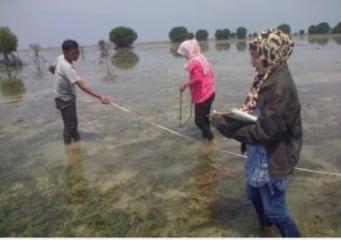
What do people think about oceans, the ocean has some of the world’s richest fishing resources. Then came the ideas to utilize oceans to be functional as land use. Based on the those ideas researchers of the Faculty of Fisheries and Marine Sciences, Bogor Agricultural University (FPIK IPB) have initiated to do sea farming. The goal is to develop marine culture production.
In the seminar on "Research Results" held at IPB International Convention Center (IICC) Bogor, recently, the Pusat Kajian Sumberdaya Pesisir dan Lautan (PKSPL Centre for Coastal and Marine Resource Studies) of Institute for Research and Community Empowerment, LPPM IPB, explained its work programs. One of which is ”CoE Sea Sea Farming and Ranching”.
"At the beginning people think that the ocean is just a part of the world cruise. Then came the idea, how about aquafarming, the farming of aquatic organisms such as fish, crustaceans, molluscs and aquatic plants. Farming implies some form of intervention in the rearing process to enhance production, such as regular stocking, feeding, protection from predators, etc. "said Dr. Aryo Damar as speaker for PKSPL LPPM. Therefore, PKSPL LPPM IPB developed and built some floating cages with local fish seedlings at Kepulauan Seribu. It was the wild fishes taken as the stocked fish seedlings. At the beginning it was grouper to be farmed, then PKSPL LPPM IPB added vaname shrimp.
"The rocky shore and islands in Semak Daun of Thousand Islands cover approximately 315 hectares. These provide diverse habitats for marine plants and animals, both above the low water mark and below, means they will be beneficial for the society. Approximately within the next 20-30 years, the reef fish will be depleted. Then there is no other way than restocking in order to ensure a continuous fresh fish supply for fisherman. It is the concept of sea farming, "he explained.
In the future PKSPL LPPM IPB expect to develop and replicate the successes of sea farming programs to other places in Indonesia. In addition, it also expects to carry out various research programs on aquaculture to produce applied technologies for communities.
Finally, PKSPL LPPM IPB hope to be able to assist the coastal communities in increasing their capacity and resilience due to the climate change and disasters. In addition, assisting coastal communities to have their alternative livelihoods is also part of their expectations, so their economic status will be sustainable. Finally, PKSPL LPPM IPB will tries its best to develop Maritime Spatial Planning and Integrated Coastal Zone Management to control environmental degradation for sustainable development. (Wied)

