IPB University Sets “Global Leadership in Innopreneurship” as Its Strategic Direction for 2027
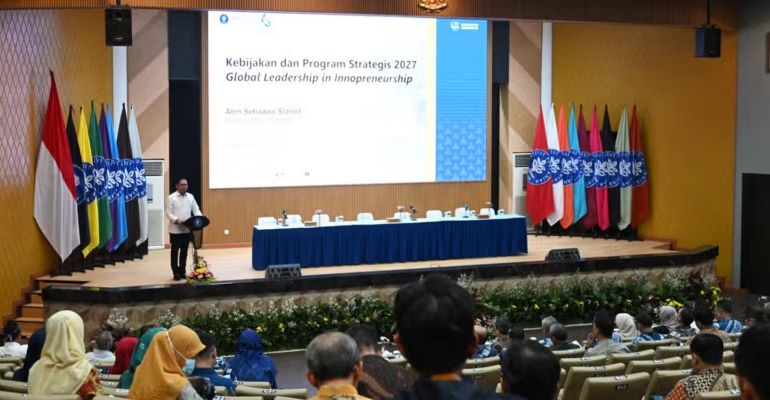
IPB University has set Global Leadership in Innopreneurship as its strategic direction for 2027 to strengthen its position as an innovative, resilient, and impactful university.
This direction was the focus of the 2027 IPB Planning and Development Meeting (Musrenbang) held at the Andi Hakim Nasoetion (AHN) Auditorium, IPB Dramaga Campus (9/9), and serves as the foundation for the preparation of IPB’s 2027 Work Plan and Budget (RKA).
Rector Dr Alim Setiawan Slamet stated that 2027 presents an opportunity to strengthen IPB University’s strategic achievements while responding to changes in the higher education landscape, the economy, technology, and national development needs.
According to him, this direction is a continuation of the milestones outlined in IPB’s 2023–2028 Strategic Plan (Renstra), following the Global Engagement phase in 2026 and preceding the Globalized Sustainable University phase in 2028.
“Next year, our focus will be on how we can quickly establish global leadership in innopreneurship. We must strengthen the Science Techno Park, develop students with techno-socio-entrepreneurial capabilities, expand living labs and Village-Up initiatives, and accelerate the commercialization of research,” said Alim.
IPB-MIRAI
The Rector explained that this strategy must be implemented based on the IPB-MIRAI principles, which are quality, inclusivity, relevance, adaptability, and impact. These principles are crucial because higher education institutions face numerous changes, ranging from fiscal pressures and budget efficiency, the food security agenda, climate change and the energy transition, the blue-green economy, to disruptions caused by artificial intelligence.
“IPB University must remain adaptable. Efficiency must be achieved without sacrificing quality, well-being, and the institution’s vision,” he said.
In the field of education, Dr Alim continued, IPB University is also focusing on increasing on-time graduation rates and the Educational Efficiency Rate (AEE). In the field of research and innovation, efforts are centered on strengthening areas such as biological resources, Agromaritime 5.0, bio-based solutions, biodiversity, and the bioeconomy.
“These priorities are directed toward the development of food and feed, biomedicine, bio-based chemicals, biomaterials, as well as bioenergy and biofuels,” he said.
Additionally, the development of Village-Up is part of a strategy to expand the impact of IPB University’s innovations through village ecosystems and startups. The program connects students, research, innovation, assets, capital, partners, and market access so that research outcomes can provide broader economic and social benefits.
Dr Alim stated that to support this agenda, the 2027 strategic program also includes the digitization of learning, strengthening the quality of research and outputs, internationalization, human resource development, strengthening governance, and asset optimization.
With these policies, he emphasized, the program must be aligned with the vision, performance targets, and impact on the university community. This planning does not stop at targets but must produce tangible changes.
“If we build an innovation ecosystem, we are not only generating knowledge but must also ensure that innovation has an impact on society,” concluded Dr Alim. (dr) (IAAS/WSG)