
IPB-D1 Chicken, An Innovation from IPB University’s Faculty of Animal Science Toward the Commercialization of Local Chicken at ILDEX 2026
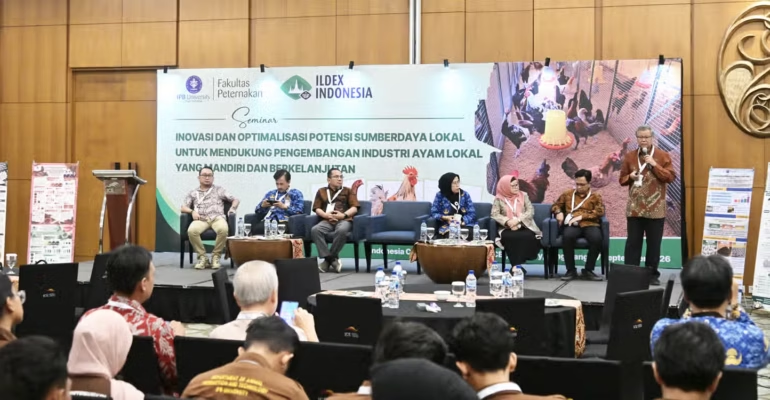
A variety of innovations resulting from research by the Faculty of Animal Science (Fapet) at IPB University were showcased at the IPB University booth during the Indonesia Livestock Dairy and Meat (ILDEX) 2026 event, held at the Indonesia Convention Exhibition (ICE) in BSD City, Tangerang, (9/16–18). One innovation that drew attention was the IPB-D1 chicken, developed as part of efforts to strengthen the self reliance of local chickens through innovations in genetics, feed, farming practices, biosecurity, and downstream processing and commercialization.
The Dean of IPB University’s Faculty of Animal Science, Prof Idat Galih, stated that the research results on local chickens developed by IPB University in collaboration with various institutions are now at a stage where they can be implemented. The next challenge is to encourage public acceptance and scale up development to an industrial level.
According to Prof Idat, developing local chicken breeds requires more than just providing high-quality breeding stock. Feed, farming systems, and biosecurity must also be integrated to ensure the chickens’ genetic potential yields maximum performance. Local chicken breeds also possess distinct characteristics and flavors, offering unique opportunities for development.
Prof Sumiati, a full professor at the Faculty of Animal Science (Fapet) at IPB University, explained that the development of the IPB-D1 chicken is supported by innovations in nutrition and feed. Her team is studying the chickens’ nutritional needs to maximize their genetic potential, performance, and production.
“Our nutrition and feed team provides support by addressing the nutritional needs of the IPB-D1 chicken to maximize its genetic potential and performance,” she explained.
In addition to supporting livestock performance, feed innovations are also aimed at increasing the added value of IPB chicken products. Prof Sumiati hopes that local chickens can attract their own consumer base as a source of animal protein due to their distinct texture and flavor compared to commercial chicken breeds.
Prof Cece Sumantri, a researcher, highlighted the commercial potential of the IPB-D1 chicken, particularly for rural communities. This chicken is considered to have good growth, resistance to endemic diseases, and the ability to adapt to local feed.
“This chicken has good growth, excellent resistance to endemic diseases, and is also highly adaptable to local feed conditions,” explained Prof Cece.
He added that the meat characteristics of the IPB-D1 chicken also hold potential for development as a value-added food product. The integration of genetic breeding and feed innovation is a crucial component of this development.
On the same occasion, Dr Agus Susanto, Chief of the Center for Livestock Development and Modernization and Animal Health at the Ministry of Agriculture, emphasized the importance of biosecurity in livestock modernization. Given that investment needs and lack of knowledge remain challenges for many farmers, he encouraged cluster based partnerships, financing for barn modernization, and biosecurity training.
The further development of local chicken breeds will be guided by the integration of breeding stock, feed made from local ingredients, housing, biosecurity, and animal health. Farmers are involved as part of participatory action research and as field laboratories. This model is expected to accelerate the commercialization of research results so that local chicken breeds can evolve from research innovations into an integral part of a productive and sustainable livestock industry ecosystem. (AS) (IAAS/SSR).

