IPB University Expert Explains the Food Technology Behind Fortified Rice
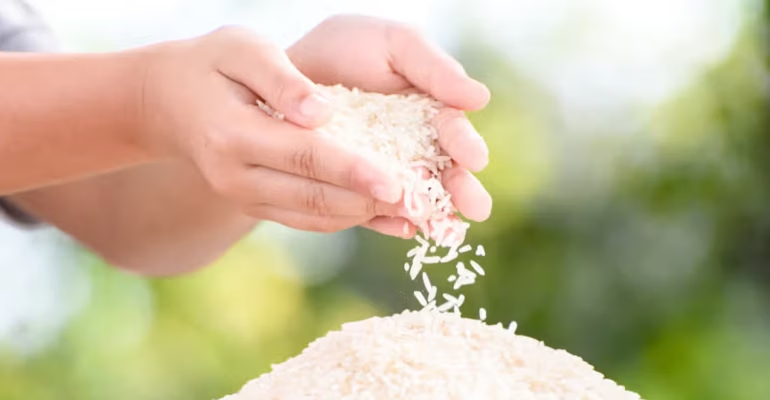
A single grain of rice that looks quite ordinary can actually contain added vitamins and minerals. This is what is known as fortified rice. Behind the process lie food technology considerations to ensure that these added nutrients actually reach the consumer’s body, rather than being lost before cooking.
How Does Fortified Rice Differ from Conventional Rice?
The Chairman of the Centre for the Development of Agricultural and Food Science and Technology in South East Asia (SEAFAST) at IPB University, Dr Puspo Edi Giriwono, explained that fortified rice differs from conventional rice in that it is enriched with micronutrients designed to provide specific nutritional benefits.
“Fortified rice is rice that has been enriched with micronutrients, namely three vitamins and two minerals. These vitamins include vitamins B1, B9 and B12, whilst the minerals are iron and zinc,” explained Dr Puspo.
One of the aims of adding these nutrients is to help tackle and reduce the risk of anaemia through the iron content. Meanwhile, zinc plays a role in supporting the immune system and optimal growth.
Three Ways to Add Nutrients to Rice
From a technological perspective, Dr Puspo explained that rice fortification can be carried out using several approaches, such as coating, dusting, or extrusion technology.
Of these three, extrusion technology is considered to have an advantage because the fortifying agents can be incorporated into the rice grains, thus providing better protection from environmental factors such as oxygen, light and heat.
On the other hand, the technology used in fortification also determines how well the nutrients are protected during processing, particularly during the washing of rice before cooking, a practice commonly followed by many people.
“Extrusion technology produces grains in which the fortifying agents are already mixed in and protected. When the rice is washed before cooking, the fortifying agents are relatively better preserved compared to technologies that merely coat the surface of the rice,” he said.
In other words, in rice where the fortifying agents merely coat the surface (such as through coating or dusting), the washing process risks causing some of these added nutrients to dissolve and be washed away with the water—before they are consumed.
Challenges in the Development of Fortified Rice
Nevertheless, Dr Puspo emphasised that the development of fortified rice must also take consumer behaviour into account, such as the habit of washing rice. This is important to ensure that the levels of added nutrients remain within the required standards after undergoing processing at the consumer level.
Strengthening the fortification ecosystem is also a priority. Producers’ access to technology and capital must be addressed to ensure that fortification is not limited to large scale producers. The availability of fortifying ingredients domestically is also crucial, as some vitamins and minerals are still reliant on imports.
Furthermore, regarding testing, given that the mixing ratio of fortifying agents to rice can reach 1:100, he emphasised that sampling methods must be capable of representing the product as a whole. “If the mixture is not uniform and the sample is not representative, the analysis results may reflect conditions that do not correspond to the product as a whole”.
Dr Puspo also highlighted the rate of degradation of each vitamin and mineral during storage. Differences in stability between fortifiants can result in some components still meeting standards, whilst others experience a decline in concentration.
“Therefore, data driven studies are needed to model changes in fortifiant concentrations during production, distribution and storage. The results of this study will then be translated into technical recommendations for producers. It is thus hoped that the implementation of fortified rice can be carried out consistently on a large scale and provide nutritional benefits to the public,” he concluded. (dr) (IAAS/HRD)