Creating a Village Aware of Food Safety: IPB University’s Food Safety KKN-T Team Holds SAPA Event in Barengkok Village
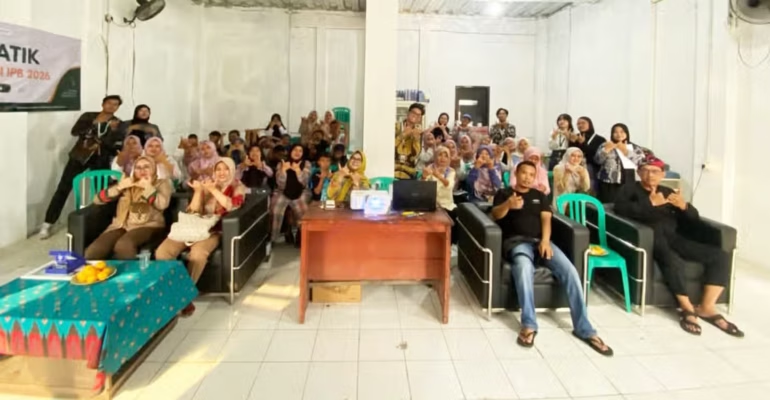
Public awareness of the importance of food safety is a key step toward creating a healthy, high quality village environment.
Through the SAPA (Safe Food Socialization and Advocacy) program, the IPB University Food Safety Thematic Community Service (KKNT) team visited Barengkok Village, Leuwiliang Subdistrict, Bogor Regency, to improve the community’s understanding of how to select, prepare, and serve safe food for their families (8/8).
SAPA engaged community members from all walks of life, ranging from children and teenagers to homemakers and school cafeteria vendors. The event began with health screenings, group exercises, and the distribution of healthy foods made from root vegetables.
Next, participants were introduced to the village food safety cadres who had received training from the IPB University Food Safety KKNT team. These cadres also played a role in delivering food safety education to the community.
Collaboration with BPOM
The IPB University Food Safety KKNT program is part of a collaboration with the Indonesian Food and Drug Administration (BPOM) to raise public awareness about food safety.
During the SAPA activity, the cadres presented material on the 5 Keys to Family Food Safety, the 5 Keys to School Food Safety, and the Cek KLIK (Packaging, Label, Distribution Permit, and Expiration Date) checklist. This education is expected to provide practical knowledge to the community while strengthening the role of the cadres as drivers of food safety in Barengkok Village.
Synergy Between Students and the Community
SAPA received a positive response from the Barengkok Village community. This activity served as a platform for interaction among students, community leaders, and residents to build a shared understanding of applying food safety principles in daily life. Active community involvement is expected to support the program’s sustainability and strengthen collaboration at the village level.
Through SAPA, the team hopes that the knowledge gained can be applied and passed on to families and the surrounding community. It is hoped that the village food safety cadres will serve as catalysts for the program’s sustainability after the KKNT period ends.
Thus, Barengkok Village can become a village that is increasingly aware, concerned, and self-reliant in achieving food safety. (*/Rz)(IAAS/LAN)