Fostering Co-Creation, IPB University and WUR Draw Up a Roadmap for Sustainable Sago Production in the Peatland Landscape of Bangka
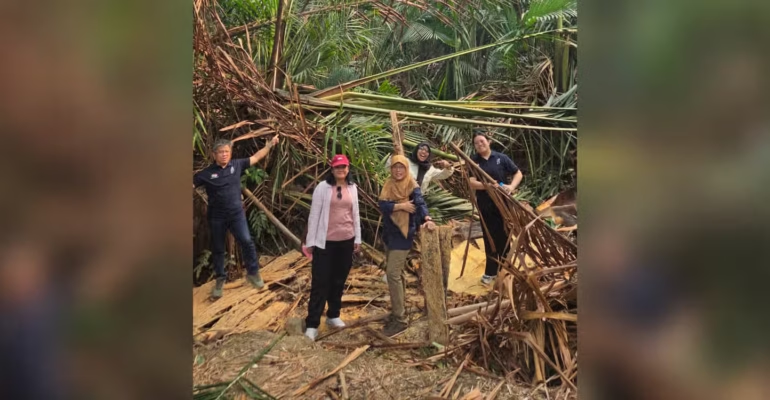
IPB University, in collaboration with Wageningen University and Research (WUR), has developed a collaborative roadmap for the sustainable and circular development of sago through co-creation activities at PT Bangka Asindo Agri (BAA), Sungailiat, Bangka Regency, Bangka Belitung Islands (9/25–27).
This initiative forms part of the Ministry of Higher Education, Science and Technology’s (Kemdiktisaintek) ‘Impactful Diaspora 2026’ Programme, managed through a collaboration between the Department of Silviculture and the Centre for Transdisciplinary and Sustainability Sciences (CTSS) at IPB University.
The focus of the collaboration is not only to position sago as a food commodity, but also to explore opportunities for utilising biomass and processing by products to create added value whilst supporting landscape sustainability, including peatland ecosystems.
Fidrianto, Managing Director of PT Bangka Asindo Agri, welcomed the collaboration as an opportunity to strengthen the development of Indonesian sago from the perspectives of technology, sustainability and the creation of added value.
“Indonesia’s sago potential is enormous, but there is still much scope for us to develop together. For us, sago should not simply be limited to flour. We need to explore how technology, product innovation, the utilisation of by products, and environmental management can form a single system that delivers added value,” he said.
According to him, collaboration with universities is important so that the developments can address the industry’s real needs whilst also providing wider benefits to society.
Co-creation was carried out through site visits, discussions with industry stakeholders, the identification of potential and challenges on the ground, and preliminary discussions on a sago development roadmap. Through these visits, the teams from IPB University and WUR observed first-hand the processing procedures and various resource flows within the sago production chain, including opportunities for improving efficiency, product diversification, and the utilisation of biomass and residues.
D Yessie Widya Sari, Secretary of the CTSS at IPB University, emphasised the importance of basing solution development on real-world conditions on the ground.
“We want to start from the actual needs and conditions on the ground. Therefore, this activity is not merely a visit, but a co-creation process to jointly explore how sago can be developed from upstream to downstream, including how the resulting residues and biomass can be given new value. The hope is that we can develop solutions that are scientifically sound, economically viable, and at the same time provide benefits for the community and the environment,” said Dr Yessie.
The event also featured Dr Aritta Suwarno from WUR as a diaspora expert specialising in ecosystem services, nature based solutions, sustainable land use, and the circular bioeconomy.
“Sago offers exciting opportunities because we are not just talking about a single commodity, but about how economic activities can be developed as part of a landscape. The challenge is how to create economic value and decent livelihoods, whilst maintaining ecosystem functions,” he explained.
This perspective becomes increasingly important when sago development is linked to peatland landscapes. Peatland ecosystems fulfil vital ecological functions, meaning that economic activities within and around them require an approach capable of balancing production, community livelihoods and ecosystem sustainability.
The initial roadmap is designed to link research with on-the-ground needs, covering the strengthening of production and value chains, the utilisation of residues and biomass, the development of value added products, capacity building for communities and businesses, and business models that support landscape sustainability.
This collaboration is expected to serve as a foundation for a shared agenda in developing sago as part of a circular bioeconomy and the sustainability of peatland landscapes. (*/Rz) (IAAS/HNF)