IPB University and PELNI Develop a Marine Business and Ecotourism Ecosystem Based on Wakatobi’s Coastal Potential
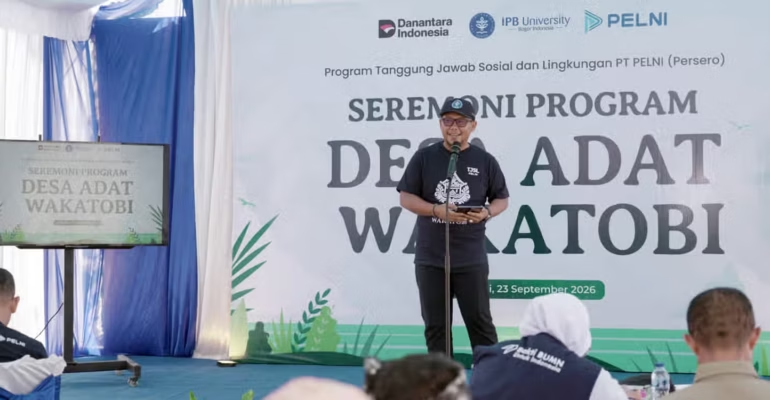
IPB University, in collaboration with PT PELNI, is promoting the development of a fisheries business ecosystem based on local potential in Wakatobi Regency, Southeast Sulawesi. One of the initiatives being developed is grouper farming on Kapota Island through the One Village One CEO (OVOC) approach and the development of floating net cages (KJA).
Danang Aria Nugroho, SE, MSi, Secretary of the Institute for Agromaritime Development and Innopreneurship Acceleration (LPAAI) at IPB University, explained that grouper development on Kapota Island is not solely focused on production, but also on building a business ecosystem that encompasses institutional management, community capacity building, market development, and downstream processing.
This approach is being implemented through the initiation and replication of a sea farming model, with floating net cages serving as one of its key innovations. “KJA are expected to serve as an entry point for developing a more structured and controlled community fisheries business ecosystem, while also creating opportunities to develop the grouper business value chain from upstream to downstream,” he explained during the program presentation (9/23).
Grouper was selected as the main commodity based on its suitability for local waters and its economic potential. The development of this commodity is expected to go beyond aquaculture activities and evolve into an integrated upstream to downstream business value chain that provides added value for the people of Kapota Island.
“For IPB University, this initiative represents one way of translating knowledge, innovation, and collaboration into concrete action within the community. Community development requires synergy among universities, businesses, government, local communities, and various other stakeholders so that innovation can grow and create sustainable impact,” Danang said.
To support the sustainability of the program, a fishermen’s group consisting of 10 members has been established. The group is expected to become the main operator of the floating net cages while also serving as the foundation for a community based economic institution capable of developing grouper farming independently and sustainably.
In addition to the presentation on the development of the grouper business ecosystem, the series of activities also included training on Institutional Governance delivered by Wildan Nurussalam, SPi, MSi, a lecturer from the Department of Aquaculture at IPB University. The training plays an important role in strengthening the capacity of the fishermen’s group to manage its organization in a more structured manner, establish clear roles and responsibilities, and support the sustainable management of the grouper farming business.
The activity was also attended by several invited guests, including Assistant I to the Regional Secretary of Wakatobi Regency Bakri, SH; Chair of the Wakatobi Regency Fisheries Office Saoruddin, SPi, MSi; Chief of the Class II Wanci Port Management Unit (KUPP) Tri Mulyoko, STrPel; Chief of the PELNI Baubau Branch; PELNI TJSL Manager Septi; representatives of Wakatobi National Park; Chief of Kabita Togo Village Tarson, SPd; Chief of Kabuta Village Laode Bahlur; Chief of Kapota Village H Jabal Nur; and Chief of North Kapota Village Nurwahid, SPd.
The participants visited the floating net cage site to directly observe the condition of the aquaculture facilities and the progress of the grouper development initiative being carried out with the local community. The visit also strengthened stakeholders’ understanding of the potential for community based fisheries development on Kapota Island.
Through this collaboration, the development of the grouper business ecosystem on Kapota Island is expected to become a model for coastal community economic development based on local potential and innovation, which can continue to be expanded and replicated in other regions. (*/Rz) (IAAS/KAL)