IPB University Expert Advocates for Integrated Disaster Education Starting in Elementary School
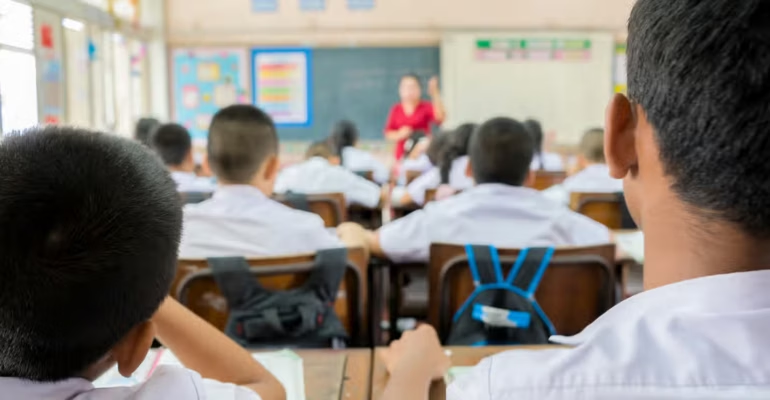
Children may not yet understand why a small fire can turn into a major disaster. However, starting in elementary school, they can be introduced to nature, disasters, and ways to protect themselves and the environment from the risks they pose.
Prof Dwi Hastuti, an expert in child care and development at IPB University, emphasized the importance of teaching disaster education starting in elementary school, including fire awareness and prevention. According to her, this education does not have to be a separate subject but can be integrated into science, social studies, and physical education classes.
“Best practices regarding disaster education in schools can be seen in what schools in Japan do. There, children are already taught about the concept of natural disasters and all types of disasters through activities integrated into science, social studies, and physical education classes, not as a separate subject,” said Prof Tuti.
According to her, a similar approach can be applied in Indonesia by introducing students to nature and various disasters, such as floods, earthquakes, typhoons, and forest fires. This introduction can begin through textbooks, storybooks, pictures, and videos about forests, rivers, oceans, lakes, mountains, and the surrounding environment.
Environmental awareness also needs to be fostered through simple practices at school, such as keeping classrooms and the school grounds clean, sweeping the yard, mowing the lawn, and picking up trash. Teachers and schools must also serve as moral exemplars for the children.
“Children are encouraged to participate in sweeping the schoolyard, mowing the lawn, and picking up trash found around the school. Schools and teachers must serve as ‘moral exemplars’ for the children. No teacher should smoke on school grounds, let alone leave cigarette butts scattered around the teachers’ lounge or classrooms,” she emphasized.
Specifically regarding fires, she believes children need to understand that fire can be both beneficial and dangerous if left uncontrolled. Fires, including wildfires, can occur either intentionally or accidentally.
Explanations about the likelihood of fires and their causes can also begin to be taught as early as elementary school. According to Prof Tuti, drills and practical exercises on handling and preventing uncontrolled fires should be part of science education.
“Elementary school is the right age for children to learn about their environment; this education can begin in first grade, particularly regarding the use of fire in daily life at home, for example, for cooking or providing light by lighting a candle,” she added.
Furthermore, when children reach third grade in elementary school, they can begin to learn about how to protect the environment, forests, rivers, oceans, lakes, and other natural features.
“Knowledge regarding the impacts of river and ocean pollution, as well as forest destruction, including forest fires, can be taught to third grade elementary school students. This is because, in third grade, the science curriculum also covers topics such as an introduction to nature, natural disasters, an introduction to hazards, and basic preparedness,” she added.
This education also requires parental involvement. Children need to be taught about both the benefits and dangers of fire when using household appliances, such as stoves or cooking appliances fueled by wood, gas, electricity, or candles. Schools can also supplement this with fire disaster drills so that students do not panic and are able to prioritize their own safety.
According to Prof Tuti, this education is not intended to scare children, but rather to build early awareness of disaster risks and the importance of protecting themselves and their environment. (dh) (IAAS/KQA)