IPB Mentored Startup ‘Planteria’ Proves Trichoderma Boosts Shallot Productivity by Up to 40 Percent
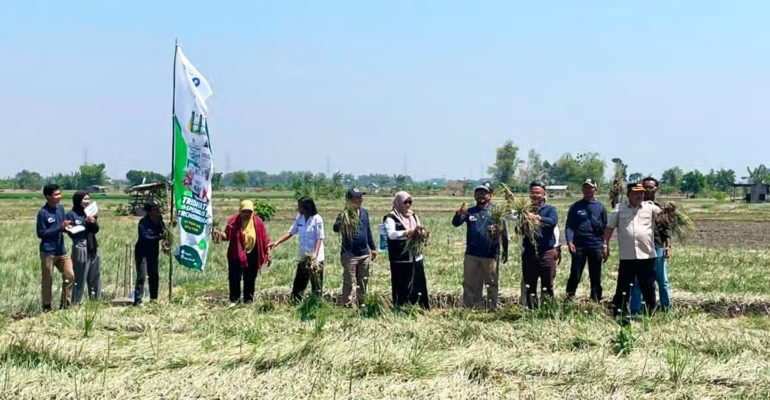
Amid efforts to reduce agriculture’s reliance on chemical inputs, TrichoMeta Thanos, a Trichoderma innovation developed through research by Planteria, an IPB University mentored startup is showing promising results.
Through the TrichoMeta Thanos product, its application in red onion cultivation in Nganjuk has increased productivity, reduced the use of chemical fertilizers, and improved soil fertility.
Planteria CEO Bambang Sutrisno stated that Trichoderma was applied to a 7.135,2 m² demonstration plot for red onions, involving eight farmers.
“The harvest results show that the use of TrichoMeta Thanos was able to increase shallot productivity by about 40 percent, improve soil fertility, and reduce chemical fertilizer use by 40 percent,” he said during the Grand Harvest and Trichoderma Demonstration Plot Field Day in Nganjuk Regency, East Java, on August 12, 2026.
This innovation is part of the commercialization of Planteria’s research findings in collaboration with IPB University faculty and researchers through the PRIME STeP Startup Business Incubation Program of IPB’s Institute for Agromaritime Development and Innopreneurship Acceleration (LPA2I).
“The hope is that all stakeholders in Nganjuk can collaborate to increase production and improve the welfare of shallot farmers through the application of appropriate technology,” said Bambang.
The Chairman of LPA2I at IPB University, Dr Handian Purwawangsa, emphasized that this initiative is a concrete example of the commercialization of university research outcomes. According to him, innovation should not stop at the research stage but must be implemented to address real world challenges in the field.
Planteria underwent a three year incubation process at LPA2I IPB through the PRIME STeP program. The Trichoderma innovation developed is aimed at reducing the use of chemical fertilizers while increasing agricultural productivity.
“Currently, LPA2I IPB University is mentoring around 72 startups through bootcamps, coaching, mentoring, and business matching to drive the development of innovations that benefit society,” he said.
Dr Handian is also committed to strengthening the branding of Nganjuk shallots to increase their added value and market competitiveness. The application of Trichoderma will continue to be tested further to reinforce evidence of the benefits of this innovation. In addition, he is encouraging the development of high-value rotational crops such as edamame soybeans.
The Regent of Nganjuk, Dr H Marhaen Djumadi, commended the collaboration between IPB University and Planteria in supporting local agricultural development. According to him, shallots and soybeans are priority commodities for Nganjuk. He also highlighted the challenge of price fluctuations in shallots due to an abundance of supply at the same time. Therefore, it is necessary to regulate planting patterns and harvest times, strengthen cooperatives, and provide farmers with access to financing and deferred sale strategies.
“Farmers have usable land, but they need knowledge and research findings from universities such as those provided by Planteria through the use of Trichoderma, which can reduce the use of non-organic fertilizers and increase production,” he said.
The event was also attended by the Assistant for Business Incubation at LPA2I and his team, the Chairman of the Nganjuk Regency Agriculture Office, the Rejoso Subdistrict Head, Field Agricultural Extension Officers (PPL) from the Rejoso Subdistrict Agricultural Extension Office (BPP), the Mojorembun Village Chief, RT and RW leaders, and representatives of farmers’ groups. The series of activities included a visit to the demonstration plot, a symbolic harvest, and a dialogue with farmers.
Through this event, LPA2I IPB and Planteria will continue to promote the wider adoption of Trichoderma technology as an environmentally friendly agricultural innovation with the potential to increase productivity, reduce dependence on chemical inputs, and support farmers’ well-being and agricultural sustainability in Nganjuk.