Why Are Forest and Land Fires in Peatlands So Hard to Extinguish? IPB Expert Reveals the Factors and Solutions
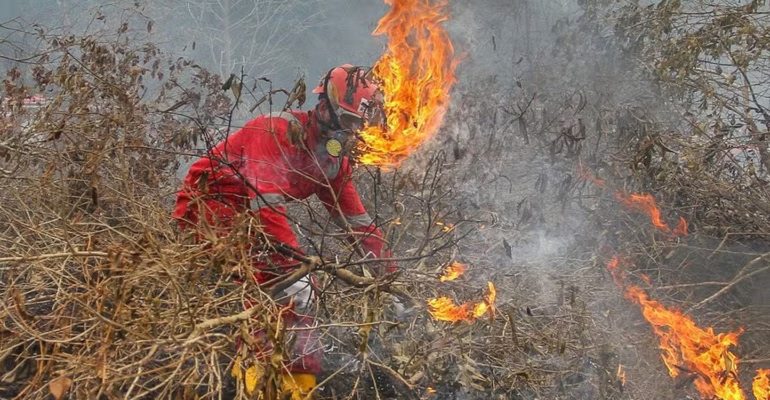
Extinguishing forest and land fires (karhutla) in Kalimantan’s peatlands is not simply a matter of putting out the flames. Even when the fire appears to be out on the surface, embers can persist and continue to spread, making it difficult to fully extinguish the fire.
This was emphasized by Prof Bambang Hero Saharjo, a Full Professor at the Faculty of Forestry and Environment and Chair of the Center for Disaster Studies at IPB University.
“The difficulty in extinguishing karhutla in Kalimantan is closely related to the characteristics of peatlands, which dry out easily and retain embers beneath the surface,” he said.
According to him, fires in peatlands can persist beneath the surface once they have penetrated the peat layer and left unburned material behind. These embers have the potential to reignite fires, especially when it hasn’t rained and the peat remains dry.
“Dried-out peat serves as highly effective fuel for sustained fires,” he said.
In addition, Prof Bambang noted that the main challenge stems not only from the fires themselves but also from limited support resources. The scarcity of water is a major obstacle, as the water table has dropped to a certain depth, making it difficult to use for firefighting efforts.
This drop in the water table, he continued, makes the peat drier and more susceptible to fire. The El Niño phenomenon and drought can also accelerate the drying process.
“Other water sources, such as boreholes, have become inoperable, as have the canals that have been built, but the available water is very limited,” said Prof Bambang.
He added that the availability of facilities and infrastructure, the capacity of firefighting teams, and their knowledge and skills regarding fires all play a role in determining the effectiveness of fire control.
On the other hand, suboptimal early warning and early detection systems result in fire risks being identified too late. Therefore, Prof Bambang believes that strict law enforcement is also necessary to encourage compliance and prevent repeated fires.
In Government Regulation (PP) No. 71 of 2014, the government has set a maximum peat water level of 40 cm to ensure the surface remains moist.
“Monitoring water levels to ensure they remain below 40 cm, strengthening early warning and detection systems, and prioritizing prevention efforts must be carried out consistently,” he said.
To prevent such incidents from recurring, Prof Bambang emphasized that all parties must comply with regulations governing peatland use, including the provision that only peat layers less than three meters thick may be utilized.
“Prevention must be the top priority by keeping peatlands wet, strengthening early detection, and ensuring that all parties are involved in sustainable peatland management,” concluded Prof Bambang. (dr) (IAAS/KQA)