Involving 73 International Students, IPB University’s OVOC Opens Opportunities for the Commercialization of Rural Commodities into Global Markets
A total of 73 international students and 15 faculty members from six countries are participating in OVOC International, part of IPB University’s Community Development – EQUITY 2025–2026 program. This program is designed to strengthen the ecosystem of community empowerment, innovation, and the commercialization of regional flagship commodities.
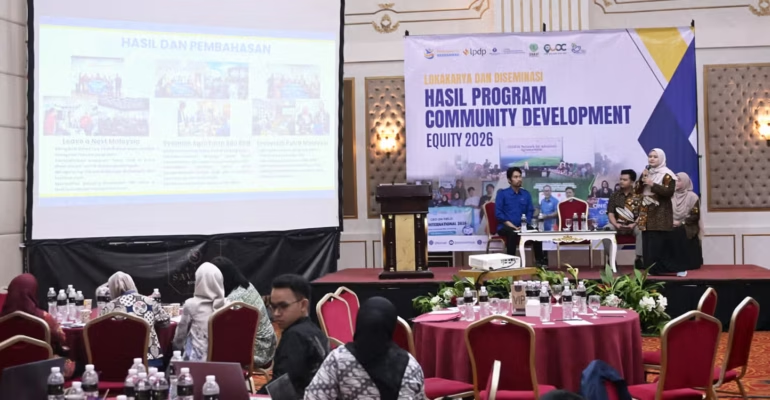
This was stated by the Secretary of LPA2I at IPB University, Danang Aria Nugroho, SE, MSi, during the Workshop and Dissemination of Results for the Community Development – EQUITY 2026 Program at the Savero Hotel in Bogor on Thursday, (8/13).
“Overall, the OVOC International program involved 13 IPB students, 73 international students, and 15 faculty members from six countries,” said Danang.
OVOC International was carried out through inbound and outbound activities. During the inbound activities, participants learned firsthand in several regions, including Bogor sweet potatoes, Ciamis California papaya, Cianjur and West Bandung horticultural commodities, as well as Garut and West Lampung coffee.
Through experiential learning, participants learn from farmers, business owners, cooperatives, government officials, and industry representatives about the commodity value chain, from cultivation and post harvest processing to marketing. This program also serves as part of an assessment to enhance the implementation of OVOC International and build a business ecosystem based on regional flagship commodities.
The evaluation results of the short courses, which are part of the program show that 87,5 percent of participants saw an increase in their knowledge.
Meanwhile, outbound activities were conducted in Belgium, Switzerland, the Netherlands, South Korea, Japan, China, Singapore, Malaysia, and Thailand. These activities resulted in networking opportunities and potential collaborations with partners in education, research, government, and industry.
One of the outcomes is export market opportunities for flagship commodities from villages under the guidance of IPB University. Collaboration with partners in China resulted in agreements with buyers for a number of commodities, including areca nuts, with a total value of approximately Rp33 billion.
Prof Handian, Chair of LPA2I at IPB University, emphasized that community service must be linked to innovation, social enterprise, and commercialization to ensure the ecosystem remains intact.
“In implementing community service programs, we cannot separate them from the downstream processing of innovations, including the commercialization of innovations. If these three elements operate independently, there will be a broken link in the ecosystem,” he said.
According to Prof Handian, strengthening the ecosystem also requires addressing financing needs and connecting innovations with farmers, land, and potential buyers.
“The ecosystem is becoming complete: IPB’s innovations are available, farmers are ready to participate, land is available, and buyers are also present,” he said.
The Community Development Program – EQUITY 2025–2026 also includes the Global Network for Advanced Agromaritime and Productive Waqf. All three initiatives are aimed at strengthening international networks, collaboration, community service, social enterprise, innovation, and commercialization.
Prof Handian hopes that the involvement of international students and faculty in OVOC will continue to be developed into partnership opportunities to develop and market community products to a wider market.
“The most important thing is how we ensure that the relationship between community service, social enterprise, and the commercialization of innovation is truly interconnected,” he concluded. (dh) (IAAS/KQA)