
GSAF 2026: Agri-PV as a Solution for Food, Energy, and Water Security in the Global South
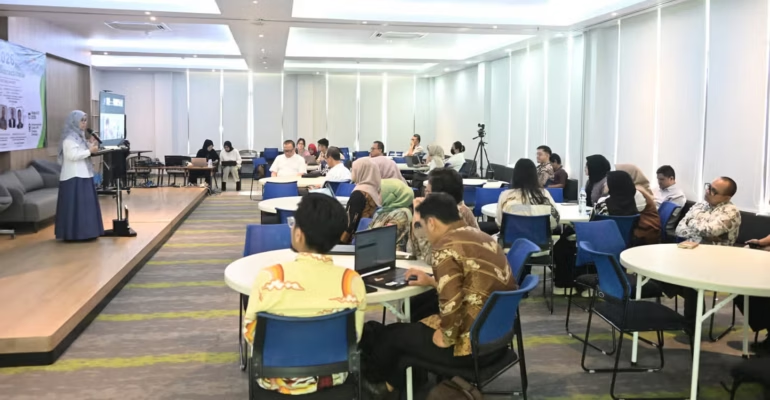
Agri-photovoltaics (agri-PV) systems are considered one of the solutions to address the challenges of food, energy, and water security amid climate change, particularly for countries in the Global South. This was highlighted at the Global South Agri-Photovoltaics Forum (GSAF) 2026, held on Thursday (8/6) at the IPB Dramaga Campus.
By combining agricultural activities with solar power generation on the same land, agri-PV can improve land use efficiency while supporting sustainable development.
IPB University’s Vice Rector for Global Connectivity, Cooperation, and Alumni Affairs, Prof Iskandar Z Siregar, stated that agri-PV offers a solution to the growing demand for land in both the agricultural and energy sectors.
“Through various international collaborations, IPB University has developed a number of agri-PV projects and is currently preparing the FEW (Food-Energy-Water) Nexus area as a center for research and innovation. “This forum is expected to strengthen global collaboration in the development of agri-PV,” he said.
On that occasion, the Dean of the Faculty of Economics and Management (FEM) at IPB University, Prof Irfan Syauqi Beik, explained that agri-PV focuses not only on technology but also on improving the well-being of rural communities. According to him, the FEW Nexus concept is becoming increasingly important because the food, energy, and water sectors are interrelated.
“In Indonesia, climate change is increasing the risk of drought, while the majority of the population still depends on the agricultural sector. Therefore, agri-PV is seen as a potential long-term solution by maintaining agricultural productivity, providing clean energy, and opening up additional income opportunities for farmers through the use of electricity or land leasing,” he explained.
Prof Sujith Ravi from Temple University added that research findings from various countries show that solar panels can create cooler microclimates, thereby reducing plants’ water requirements. In fact, some crops, such as coffee and cardamom, show better growth under solar panels.
“However, each region requires an agri-PV design tailored to local climate conditions, crop types, and community needs,” he added.
The commitment to agri-PV development is also supported through a partnership between the South Korean government and IPB University, the National Development Planning Agency (Bappenas), and Indonesian AID. This collaboration encompasses the development of a master plan, capacity building, and the use of artificial intelligence (AI) to support energy production and agriculture.
“Agri-PV development must preserve the land’s function as a food-producing area. This technology aligns with the Indonesia Emas 2045 vision because it supports the transition to clean energy without compromising food security. Various ongoing pilot projects are expected to serve as the foundation for formulating agri-PV development policies in Indonesia,” stated Yusuf Suryanto, ST, MSc, Director of Transmission, Electricity, Aviation, and Space at Bappenas. (Ez) (IAAS/WSG)

