IPB University Strengthens a Pesantren Based Rice Ecosystem in Collaboration with Bank Indonesia in East Java
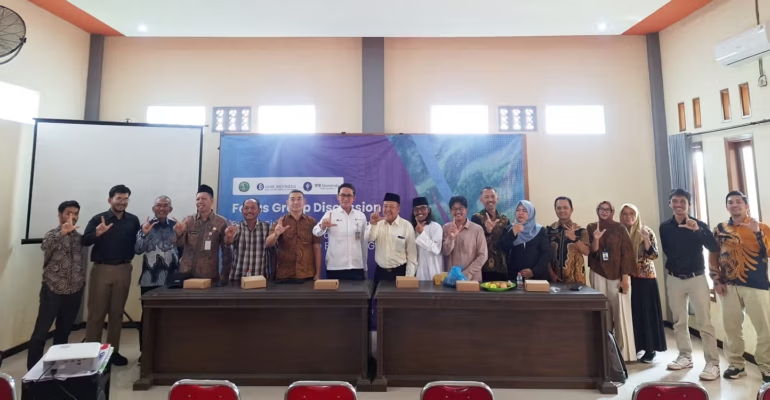
The Center for Islamic Business and Economic Studies (CI-BEST) at IPB University, in collaboration with Bank Indonesia, is developing a pesantren based rice ecosystem as a model for strengthening food security and controlling inflation in Lamongan and Jombang Regencies, East Java.
This collaboration is being implemented through the Islamic Boarding School Economic Self-Reliance Program, which is part of the National Movement for Food Inflation Control (GNPIP). The initiative began with a Synergy Forum and Discussion with the Lamongan Regency Regional Inflation Control Team (TPID) at the Sunan Drajat Islamic Boarding School, followed by a session at the Fathul Ulum Islamic Boarding School in Jombang Regency.
Partnering with Islamic Boarding Schools to Pioneer Economic Digitalization
At the event in Lamongan, the forum brought together local government officials, Islamic boarding schools, farmers, and various stakeholders to strengthen the rice supply chain from upstream to downstream.
A representative from Bank Indonesia’s Department of Sharia Economics and Finance (DEKS), Yason Taufik Akbar, MSc, emphasized that this program is designed to shorten the food distribution chain, which has traditionally been too long.
“Our food trade routes often pass through five to six points, causing consumer prices to skyrocket. Through this program, we’re cutting that chain to make the distribution route more efficient directly from farmers, processed at the Islamic boarding schools’ rice milling units (RMUs), and purchased by the boarding schools and regionally owned enterprises,” he said.
He also encouraged the implementation of contract farming and the productive use of zakat, infaq, sadaqah, and waqf (ZISWAF) funds as an alternative source of financing for the farmers under the program’s guidance.
Didik, Research Director at the Sunan Drajat Islamic Boarding School, stated that his boarding school already has a strong business ecosystem. He explained that the boarding school’s Toserba (Toko Rakyat Serba Ada) retail network currently operates 100 retail locations, with plans for a new expansion in Sidoarjo. This boarding school, a pioneer in economic digitalization, is also developing a broiler chicken farm with a capacity of 600.000 birds.
In Lamongan, the forum also featured a discussion with farmers from Canggah Village, who shared various challenges they face in farming, ranging from water shortages, rat and planthopper infestations, to technical issues with fertilization.
In response, a team of agricultural experts from IPB University provided guidance through bio-immunization technology, recommendations for adaptive crop varieties, the installation of automatic weather stations (AWS), soil testing, and the development of a three hectare demonstration plot supported by the Farmers’ Group (Gapoktan).
MOU for Farmers to Purchase IPB 9G Rice Harvest
The program was subsequently expanded to Jombang Regency through a partnership with the Fathul Ulum Islamic Boarding School. At this location, development efforts focused on establishing a partnership model between the boarding school and the Sugihwaras the Farmers’ Group (Gapoktan), which is expected to be replicated in various regions.
“Through this rice ecosystem pilot project in Jombang, we are moving toward the development of a pesantren based food security model that is ready to be widely replicated across various regions of Indonesia,” said Yason.
The program in Jombang also introduced high yielding varieties developed by IPB University, namely IPB 9G, IPB 13S, and IPB 15S. Cultivation Coordinator Dr Ahmad Junaedi explained that supporting infrastructure, such as vertical dryers and AWS, has been set up to support cultivation.
“The productivity of IPB’s new seeds has proven promising.” Gus Zahir, chairman of the cooperative representing the farmers, confirmed, “The average yield for the IPB 9G rice variety in the first planting season was 6,3 metric tons per hectare. The second planting season’s harvest is expected by the end of July 2026.”
This series of activities in Jombang concluded with a memorandum of understanding (MoU) between the farmers and Botani Seed regarding the purchase of the harvest, specifically the IPB 9G variety for one year.
Through collaboration with Bank Indonesia, local governments, Islamic boarding schools, regionally owned enterprises (BUMD), cooperatives, and farmer groups, IPB University hopes that this pesantren based rice ecosystem model will create a more efficient supply chain, guarantee price stability for farmers, strengthen control over food inflation, and serve as a model for national food security that can be implemented in various regions. (*/Rz) (IAAS/KQA)