IPB University Researcher’s Innovation Transforms Seaweed Waste and Fish Offal into High Value Organic Fertilizer
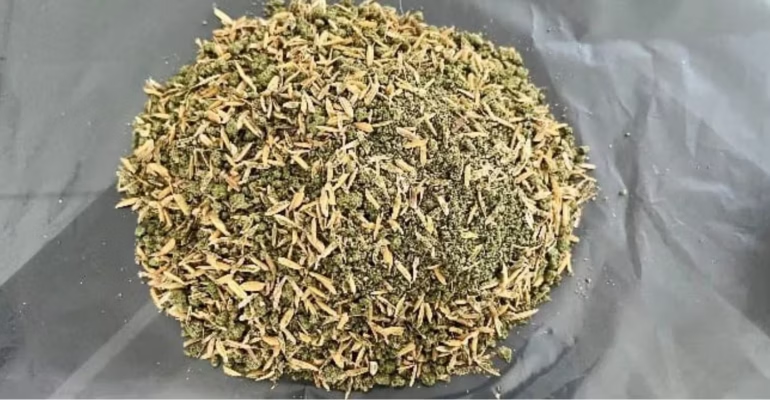
Industrial waste from seaweed processing and fisheries, long regarded as an environmental challenge, has been transformed into an innovative organic fertilizer by IPB University Prof Nurjanah.
Through the development of bokashi fertilizer made from seaweed salt residue, Prof Nurjanah offers an environmentally friendly solution that not only improves soil fertility but also promotes sustainable agriculture through the principles of zero waste and the circular economy.
The bokashi fertilizer is produced from organic raw materials enriched with seaweed salt residue, which serves as a source of macro and micronutrients. Fish offal waste is also incorporated to enhance the fertilizer’s nutritional content, resulting in a more comprehensive nutrient profile than conventional organic fertilizers.
“This innovation utilizes seaweed salt residue and fish offal waste as value added raw materials, supporting the concepts of zero waste and the circular economy while improving the nutritional quality of the fertilizer,” said Prof Nurjanah.
According to her, one of the innovation’s main advantages is the abundant availability of raw materials. Seaweed salt residue, terrestrial organic waste, and fish offal are by products of the seaweed processing, fisheries, and agricultural industries that have not yet been optimally utilized.
Utilizing these waste materials not only ensures a sustainable supply of raw materials but also helps reduce waste accumulation while creating new economic value.
Nevertheless, Prof Nurjanah acknowledged that product development still faces several challenges, including maintaining consistent raw material quality, controlling the production process to ensure stable fertilizer quality, and building farmers’ trust, as many still rely heavily on chemical fertilizers. In addition, the product must undergo quality testing, obtain regulatory approval, and be supported by an effective distribution and storage system before it can be commercialized on a wider scale.
On the other hand, the market potential for bokashi fertilizer is considered highly promising. Growing demand for organic fertilizers and increasing public awareness of sustainable agriculture have created significant opportunities for the development of this innovation. Statistics Indonesia (BPS) reported that Indonesia still imported approximately 5.367 tons of organic fertilizer in 2023, indicating that domestic production has yet to fully meet national demand.
“Seaweed salt residue based bokashi fertilizer has the potential to become an alternative to reduce dependence on chemical fertilizers. In addition to being environmentally friendly, it offers a more complete nutrient composition thanks to the combination of seaweed salt residue, organic waste, and enzymes derived from fish offal,” Prof Nurjanah explained.
The fertilizer is produced through the fermentation of organic materials using locally sourced microorganisms (MOL), prepared from biological waste, coconut water, palm sugar, and salt. Seaweed salt residue is then mixed with rice husks and rice bran, sprayed with the MOL solution, and fermented for seven weeks until mature bokashi fertilizer is obtained and ready for application.
Through this innovation, Prof Nurjanah hopes that the bokashi fertilizer will enhance agricultural productivity in a sustainable manner, reduce dependence on chemical fertilizers, and strengthen the implementation of zero waste and circular economy principles, creating added value for Indonesia’s agriculture, fisheries, and seaweed processing industries. (dh) (IAAS/CAA)