IPB University Professor: Extremely Strong El Nino Begins to Threaten Global Food Security
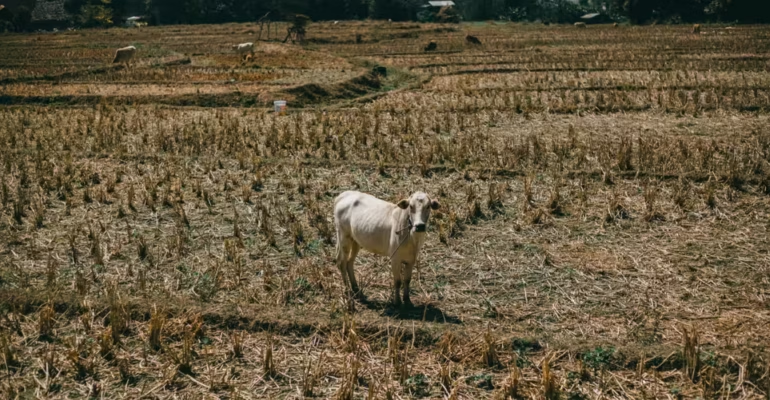
The threat to global food security is intensifying as the El Niño phenomenon has now reached the very strong category. Data from the National Oceanic and Atmospheric Administration (NOAA) reports that the Nino 3.4 index on September 2, 2026, reached +2,7°C (super/very strong), marking the highest level on record since 1950.
Prof Dwi Andreas Santosa, a professor at the Faculty of Agriculture and Chairman of the Biotech Center at IPB University, stated that this situation is not merely a matter of drought. This climate phenomenon has the potential to disrupt global food production and supply, while also driving up the prices of several commodities through 2027.
“Currently, El Niño has entered an alarming phase, the very strong category. The strongest impacts on Southeast Asia are expected to occur in late 2026 and early 2027,” he said.
Disrupting Food Production
Prof Dwi Andreas explained that El Niño affects the planting season. He estimates that the very strong El Niño will persist until February 2027, while strong to moderate conditions could continue through April 2027.
“This year’s rainy season is also expected to be delayed until November or December, with lower rainfall. As a result, the first planting season could be pushed back, and rice production in 2027 risks being constrained once again,” he explained.
Thus, he said, the food issue is not only about current prices but also about ensuring that supplies remain available when El Niño’s impact begins to affect agricultural production.
Rise in Rice Prices
Southeast Asia is one of the world’s major regions for rice production and trade. India, Thailand, Vietnam, and Myanmar, as major rice suppliers, are also regions sensitive to El Niño. Production disruptions in these countries could put pressure on global rice supplies and prices.
This pressure is beginning to be reflected in global food price movements. The Food and Agriculture Organization (FAO), in its Rice Price Update (4/9/2026), noted that the FAO Food Price Index rose from 130,8 points (July) to 133,3 points (August). The FAO rice price index also rose from 108,4 (July) to 109,0 (August), with the increase primarily driven by indica rice (the type of rice typically consumed by the Indonesian public), which rose from 110,8 (July) to 112,2 (August).
What about Indonesia?
“Indonesia, too, faces complex challenges. On one hand, rice production in 2025 increased by 13,29 percent, and government rice stocks reached their highest level. However, this increase in production and the size of these stocks have not directly translated into lower rice prices at the consumer level,” said Prof Dwi Andreas.
He noted, for example, that the price of medium-grade rice in traditional markets has continued to rise. From Rp15.800 per kilogram in February 2026, the price rose to Rp16.370 in August and reached Rp16.458 in September 2026.
According to him, one of the issues lies in the dynamics of paddy absorption. From January–July 2026, the production surplus reached 4,03 million metric tons of rice equivalent. Of that amount, approximately 3,5 million metric tons were absorbed by Bulog, leaving only about 0,5 million metric tons for the market. At the same time, the price of harvested dry paddy continued to rise, reaching Rp7.646 per kilogram in August.
“The government’s massive rice stockpile cannot automatically help control market prices,” he said.
He noted that food governance needs to be strengthened, particularly through data-driven policies, improvements in government stock management, increased supply elasticity, and enhanced cooperation between the government and the private sector.
“These measures are necessary to prevent climate and food market pressures from escalating into a broader food crisis,” he concluded. (AS) (IAAS/WSG)