
IPB 9G Rice Variety Introduced in Merauke, Farmers and the IPB Patriot Expedition Team Collaborate
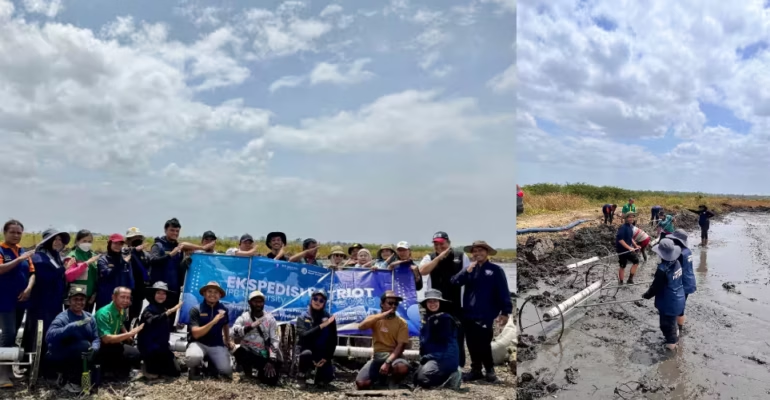
A stretch of farmland in Semangga District, Merauke Regency, served as the site for the launch and field trials of the IPB 9G rice variety. This event brought together the IPB University Patriot Expedition Team (TEP) from several districts with farmers and various stakeholders as part of efforts to expand opportunities for collaboration and agricultural innovation in the Salor Transmigration Area.
The Chairperson of IPB University’s TEP, Dr Muhammad Syukur Sarfat, explained that planting IPB 9G in Merauke provides an opportunity to observe firsthand how this high yielding variety grows under the environmental conditions of South Papua.
“Hopefully, this demonstration plot will prove beneficial for agriculture in Merauke in the future, particularly for field testing the IPB 9G variety, which has never been planted in the Papua region,” said Syukur (9/19).
In addition to serving as a testing site for the variety, the demonstration plot is also designed as a shared learning space. The team hopes that local farmers and agricultural extension workers will continue to maintain and monitor the plants after the team’s assignment ends. Thus, the field testing process will not stop at planting but will continue until data on growth and harvest yields are obtained.
Support was expressed by Dr Oeng Anwarudin, the Person in Charge (PIC) of Food Self Sufficiency for Merauke Regency. He expressed his appreciation for the activities carried out and hoped that the harvest yields would demonstrate positive results.
In his remarks, he also emphasized the importance of crop care and sufficient production inputs in implementing the Modern Agriculture System – Advanced Agriculture System (PM-AAS). According to him, this system has the potential to support increased production but still requires optimal management and care to ensure healthy crop growth.
Meanwhile, the Chief of the South Papua Center for Agricultural Modernization (BRMP) welcomed the activities carried out by TEP IPB University. He hoped that the IPB 9G variety would prove suitable for the local environmental conditions and contribute to increased agricultural productivity in Merauke.
The next phase is equally important. Plant growth, maintenance, soil conditions, and crop yields must be continuously monitored so that the field trial can provide a more comprehensive picture of IPB 9G’s performance in the region.
Through this initiative, TEP IPB University is not only introducing a new variety to Merauke’s farmlands but also fostering a collaborative learning process. It is hoped that this demonstration plot will yield new insights that can inform the development of rice farming in the Salor Transmigration Area and the broader Merauke region.
Increasing the Circular Economy
The day before (9/18), the team also visited the Berkah Vitari Rice Milling Unit (RMU) along with farmers who are members of the Farmers’ Group Association (Gapoktan) in Tanah Miring District. This activity is part of an effort to strengthen farmers’ understanding of the circular economy while also strengthening collaboration between TEP IPB University, farmers, farmers’ groups, and rice processing businesses.
During the visit, farmers were introduced to the process of turning rice husks which are generally considered waste into rice husk charcoal. This product can be used in agricultural activities, including as a material that supports the use of organic matter and improves growing media. Thus, the rice production process can be transformed into a more sustainable utilization cycle. (*/Rz) (IAAS/DON)

