IPB University and Bridgestone Partner on Microbiome Research for Rubber Trees
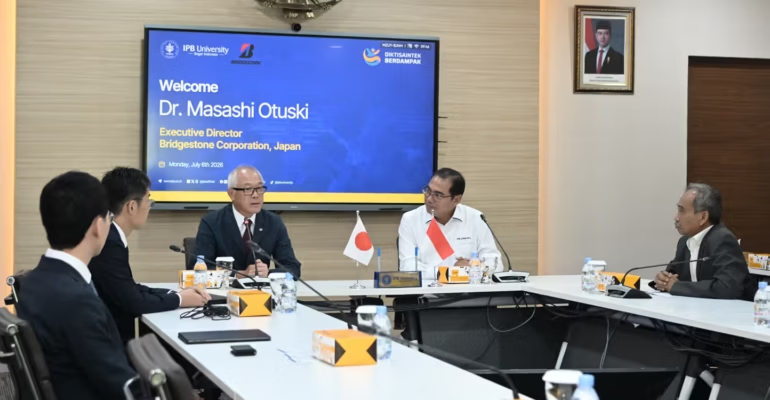
IPB University has partnered with Bridgestone Corporation to strengthen research and development of sustainable rubber trees through the use of the microbiome.
This collaboration is expected to drive innovation in improving the health, productivity, and adaptability of rubber trees while strengthening synergies among universities, industry, and international partners.
The partnership was formalized with the signing of a memorandum of understanding (MoU) by IPB University Rector Dr Alim Setiawan Slamet and Bridgestone Corporation Executive Director Dr Masashi Otsuki in the Rector’s Conference Room at the IPB Dramaga Campus on (6/6). On the same occasion, a memorandum of agreement (MoA) was also signed between the Faculty of Agriculture at IPB University and Bridgestone Corporation.
Also present at the event were Toshihiro Uchiyama, General Manager of the Sustainable Technology Strategy and Research Department at Bridgestone Corporation, and Ryosuke Ando, Manager of the Agriculture and Biotechnology Research Section.
In his remarks, the Rector of IPB University, Dr Alim Setiawan Slamet, expressed his appreciation for Bridgestone’s commitment to strengthening its partnership with IPB University.
“It is an honor and a pleasure to welcome the team from Bridgestone. I would like to express my deepest appreciation to Bridgestone Corporation for visiting IPB University and for its commitment to strengthening our partnership through the signing of this cooperation agreement today,” he said.
He explained that this collaboration also involves Nagoya University as a strategic partner in this trilateral collaboration.
“Today’s signing marks an important milestone in a partnership that began with a collaborative research initiative between Prof Suryo Wiyono of IPB University and Bridgestone regarding rubber tree diseases. We are delighted to see this collaboration evolve into a broader institutional partnership,” he said.
According to him, the natural rubber industry currently faces various challenges, ranging from plant disease control to improving productivity and sustainability. Bridgestone has strong experience and resources in the tire and rubber industries, while IPB University contributes through its scientific expertise in agriculture, tropical biosciences, and plant health. Nagoya University complements this collaboration through its strengths in bio-agricultural sciences.
“Together, IPB, Bridgestone, and Nagoya University have formed a partnership that bridges the worlds of industry, academia, and international cooperation. This is an ecosystem capable of producing innovations that have a real impact, not only in the laboratory but also in the field,” he added.
The rector hopes this partnership will foster collaborative research on the health, productivity, and sustainability of rubber trees, open up opportunities for student internships and knowledge exchange, strengthen innovation development, and contribute to addressing various global challenges through science based solutions.
Microbiome Research
Meanwhile, the Dean of the Faculty of Agriculture at IPB University, Prof Suryo Wiyono, explained that the main focus of the research is the development of the rubber tree microbiome the community of microorganisms living around the plant’s roots.
According to him, harnessing the microbiome has the potential to enhance the growth, productivity, and adaptability of rubber trees, thereby supporting the development of more sustainable plantations.
“This collaboration focuses on research into the rubber tree microbiome. In the future, it is hoped that this microbial community can be utilized to improve the growth, production, and adaptation of rubber trees,” he explained.
He added that the results of this research are intended to be applied to rubber plantations covering an area of approximately 50 thousand hectares in North Sumatra and South Kalimantan. (dh) (IAAS/EPK)