Empowering Women’s Economic: IPB University Holds Training on Mocaf Flour Production and Processed Products
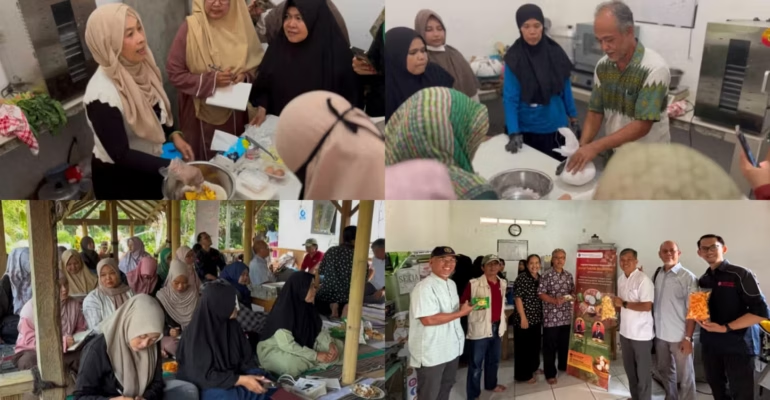
The Faculty of Engineering and Technology at IPB University successfully held a training session on the diversification of local food products using Mocaf (modified cassava flour) at the Setia Farmers’ Group in Cangkrang Hamlet, Cikarawang Village, Dramaga Subdistrict, Bogor Regency, some time ago.
This initiative, which aims to promote women’s economic empowerment in the area surrounding the campus, is part of the Community Service Program (PPM) led by faculty members from the Biosystems Engineering Division. The training was attended by 21 female participants who are members of the Bogor branch of Rumah Keluarga Indonesia (RKI), led by Wiwit Munggarani.
This training initiative was conceived as a practical solution to the limited diversification of local food sources in rural areas, amid the community’s high dependence on imported wheat flour.
Cassava, one of West Java’s leading commodities, can serve as the primary raw material for producing mocaf flour. Through a fermentation process, mocaf yields a flour with a more neutral texture and flavor compared to regular cassava flour.
In his remarks, Prof Rokhani, Chief of the Biosystems Engineering Division at IPB University, emphasized the importance of bridging the gap between academic research findings and real world needs in the field.
that remains confined to the laboratory will not mean much if it does not reach the people who need it. Through activities like this, we want to ensure that the knowledge developed at IPB truly provides direct benefits to the community and empowers women,” he said.
He added that food diversification based on local raw materials is a strategic step to strengthen food self-reliance while opening new economic opportunities for households. Dependence on a single type of food makes communities highly vulnerable to various risks, such as crop failure, climate change, or distribution disruptions.
Dr Nanik Purwanti, a lecturer in the Biosystems Engineering Division, began the session by explaining the potential, business opportunities, and variety of processed products made from mocaf flour, such as noodles, biscuits, cookies, cakes, bread, and other gluten free products.
All participants, accompanied by a team of lecturers and members of the Setia Farmers’ Group, also gained hands-on experience processing mocaf flour into ready to eat food products, namely chicken noodles made with mocaf flour and cookies. The Chairman of the Setia Farmers’ Group, Ujang, gave participants a live demonstration of the hygienic process for making mocaf flour.
This interactive educational session was warmly received by the participants, who are beginning to realize the economic value of cassava a commodity that has long been sold raw at low prices.
“Before, we only knew that cassava could be boiled or fried. Now we understand how to process it into flour and use it to make noodles, cookies, and other healthy food products. The knowledge is very useful, especially since we got to practice right away, so it’s easier to understand and remember,” said one of the participants.
In addition to the economic aspects, mocaf flour also offers sustainability in terms of national food security as an alternative to wheat. Moving forward, follow up mentoring programs will continue to be rolled out so that these cassava based processed products can be upgraded and be ready to compete in a broader market.
Prof Rokhani, who also serves as Vice Chief of the Institute for Agromaritime Development and Innopreneurship Acceleration (LPA2I) in the Business Incubator and Industrial Partnership Division, also invited participants to enhance their skills in producing biscuits, cookies, bread, and croissants at the Teaching Industry facility at IPB University’s Science Techno Park (STP). (*/Rz) (IAAS/FHD)