
The International Summer Course Program of the Faculty of Forestry and Environment at IPB University Introduces Waqf Forests and Social Forestry
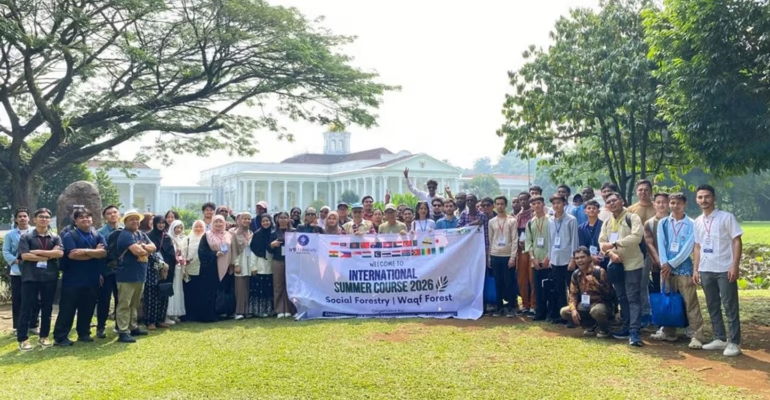
The Department of Forest Management, Faculty of Forestry and Environment, IPB University, held an International Summer Course (6/22–26) focusing on social forestry and waqf forests.
The event was attended by 30 participants from various universities in different countries, including Algeria, Australia, Bangladesh, Brunei Darussalam, China, the Philippines, The Gambia, Ghana, Indonesia, Japan, Cambodia, Malaysia, Mali, Nigeria, Pakistan, Singapore, Sudan, Tajikistan, Thailand, Timor Leste, Turkey, and Yemen.
During the first and second days, participants attended classroom sessions with speakers from academia, the private sector, government, and relevant partners. The social forestry curriculum covered social forestry policies in Indonesia, community access rights, collective action, local institutions, community governance, livelihoods based on social forestry, agroforestry, market access, product branding and value chains, ecotourism, gender equality and social inclusion, as well as the management of tenure conflicts and customary forests.
In the session on waqf forests, participants also learned about the basic concepts of waqf forests, the urgency of waqf for conservation, nazhir governance, waqf forest institutions, green financing, monitoring and evaluation, social accountability, ecotourism, the triple bottom line, and the design of waqf forest based mini projects.
On the third day, participants took an educational visit to the Bogor Botanical Gardens and the Zoological Museum. Through this activity, participants gained a deeper understanding of biodiversity, conservation, and the richness of tropical ecosystems. The visit was part of the field learning process before participants continued their field trip the following day.
On the fourth and fifth days, participants went on a field trip to the Cikole Village Forest Community Organization (LMDH) in Lembang, West Bandung. During this field activity, participants learned firsthand about forest management practices, including how forest areas can be managed to support ecological functions, social benefits, and economic opportunities for the community.
One participant, Muhammad Awais from Pakistan, noted that this activity provided a valuable learning experience in understanding social forestry practices in Indonesia.
“This program gave me a very valuable opportunity to learn how social forestry is implemented in Indonesia. I gained new insights into community based forest management, the livelihoods of local communities, and the importance of collaboration in achieving sustainable forest governance,” he said.
Similarly, Dhoha K Berghout from Algeria also said, “I learned many new things, especially about how waqf forests can serve as an innovative approach to supporting conservation, environmental financing, and community empowerment. This program provides a broader perspective on how Islamic values, forest management, and the principles of sustainability can go hand in hand for the future of the Earth.”
Through a series of sessions, this program aims to strengthen participants’ understanding of the importance of social forestry in supporting community well being, strengthening local institutions, developing forest based enterprises, conserving biodiversity, and ensuring sustainable forest management. This initiative also encourages participants to view waqf forests as a socio-ecological innovation that bridges spiritual values, forestry science, professional governance, community participation, and sustainable conservation. (*/Rz) (IAAS/DON)

