IPB University’s FEM 25th Anniversary: Promoting Sustainable and Equitable Economic Transformation
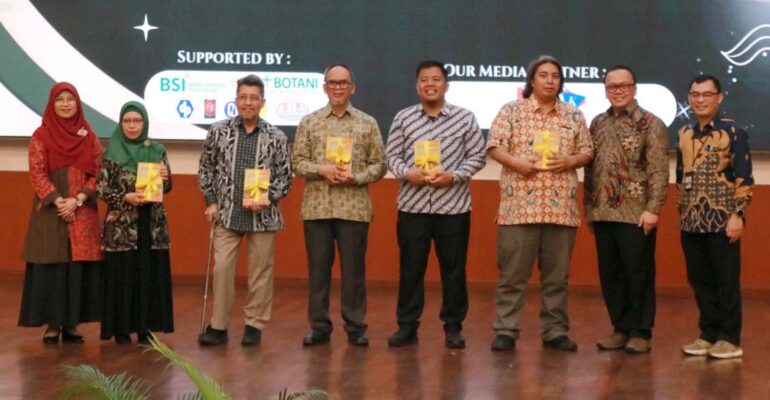
The Faculty of Economics and Management (FEM) at IPB University celebrated its 25th anniversary under the theme “Towards Sustainable Economic Transformation” at the FEM Auditorium, Dramaga Campus (6/3).
This celebration serves as a moment of reflection on FEM’s quarter century journey and a reaffirmation of its commitment to continue contributing to education, research, and innovation that support Indonesia’s inclusive, equitable, and sustainable economic development.
The event was attended by faculty and staff, alumni, partners, and stakeholders. The program included a critical analysis of Indonesia’s economy, the launch of a new arrangement of the FEM March, the signing of a cooperation agreement with Media Republika, the inauguration of ESPOLEA FEM x SSMI, the launch of the FEM Orange Book 2026, the presentation of the FEM Award, as well as various appreciation and entertainment activities.
In his remarks, the Dean of FEM IPB University, Prof Irfan Syauqi Beik, stated that the 25th Anniversary serves as a significant milestone to strengthen FEM’s role in addressing various national development challenges. According to him, higher education institutions have a responsibility not only to produce high quality graduates but also to generate ideas, innovations, and solutions that provide tangible benefits to society.
Meanwhile, the Acting Rector (Plt) of IPB University, Prof drh Deni Noviana, emphasized that the chosen theme is highly relevant to the current global situation, which is facing various economic uncertainties. Economic transformation, he noted, must be directed toward building a system that is more inclusive, resilient, and science based.
“In this context, FEM holds a strategic position as a center for the development of ideas and solutions capable of addressing the nation’s various challenges. I commend FEM’s achievements over the past 25 years, which have consistently demonstrated tangible contributions in the fields of education, research, and community service,” he said.
Critical Assessment of the National Economic Condition
One of the main agendas of this celebration was the presentation of a Critical Assessment of Indonesia’s Economic Condition by Prof Irfan Syauqi Beik. In his presentation, he highlighted that Indonesia’s economic growth, which reached approximately 5,6 percent in the first quarter of 2026, has not yet fully addressed the inequality in the distribution of prosperity.
“Therefore, a growth through equity approach is needed a development strategy that prioritizes equity as the primary instrument to generate more inclusive and sustainable economic growth,” he emphasized.
Prof Irfan also highlighted the slowdown in the manufacturing sector, which has the potential to trigger premature deindustrialization and reduce the capacity to create formal jobs. Therefore, strengthening the real sector and enhancing linkages between large industries and micro, small, and medium sized enterprises (MSMEs) must be a priority in national economic development.
Additionally, relatively high interest rate policies are seen as capable of suppressing business activity, particularly among MSMEs that require access to financing. In this regard, the development of partnership based and profit sharing financing systems, including the optimization of Islamic financial instruments, serves as an alternative that needs to be strengthened to support the productive sector.
Another critical point is the optimization of Islamic social finance instruments such as zakat, infak, sedekah, and wakaf (Ziswaf) as part of a strategy for poverty alleviation and the strengthening of social protection. The transformation of the agricultural and agribusiness sectors through technological modernization, increased productivity, secure land access, and fair financing for farmers must continue to be promoted to achieve national food self sufficiency.
Prof Irfan also emphasized the importance of strengthening the social dimension of the national financial system. In his view, the social function of the banking sector needs to receive greater and more measurable attention within the financial sector oversight system.
“Therefore, the social function needs to be incorporated into the indicators for assessing a bank’s health, both for conventional and Islamic banks, so that the success of financial institutions is not only measured by profitability and stability, but also by their contribution to economic equality, financial inclusion, community empowerment, and the improvement of social welfare,” he said.
As it enters its 25th year, FEM IPB University is committed to continuing to contribute to driving Indonesia’s economic transformation toward sustainability, inclusivity, resilience, and equity. (*/Rz) (IAAS/FHD)