Why Do Forest Ecosystem Services Need to Be Valued? Here’s Prof Bahruni’s Explanation
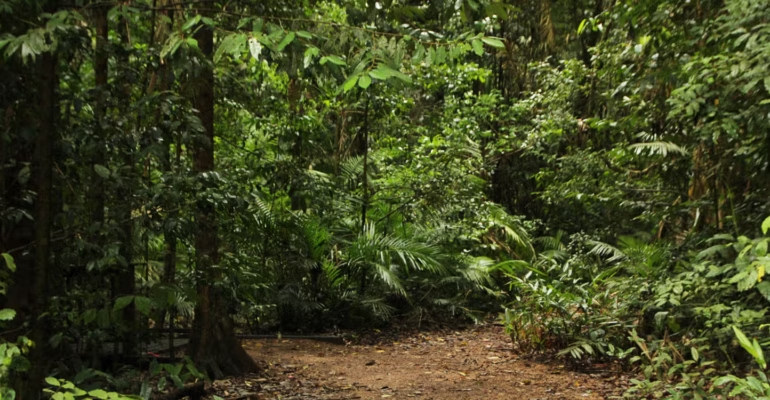
Valuing forest ecosystem services is a crucial step toward promoting green economic restoration in the forestry sector. Prof Bahruni, a professor at the Faculty of Forestry and Environment at IPB University, believes that forests should be viewed not merely as a source of timber, but as natural capital and ecological infrastructure that underpin community well being.
Prof Bahruni explained that forests provide a wide range of benefits, from timber, food, and biomass energy to climate regulation and water management services. However, some of these services lack a market price and are therefore often considered free. This situation can lead to environmental services being undervalued in economic and land use policies.
“Valuing ecosystem services is necessary so that the benefits of forests, which have long been invisible in market transactions, can be factored into decision-making,” said Prof Bahruni during his Inaugural Lecture as a Full Professor at IPB University on Saturday (8/22).
According to Prof Bahruni, this issue is becoming increasingly critical amid the depletion of Indonesia’s natural capital. Based on 2025 data from the Food and Agriculture Organization (FAO), Indonesia’s forest area has decreased from approximately 116 million hectares in 1990 to about 96 million hectares in 2025.
In addition, approximately 14,98 million hectares of production forests are currently deforested, while overall there are about 24 million hectares of forest areas requiring restoration, according to 2024 data from the Ministry of Environment and Forestry (KLHK).
He emphasized that the valuation of forest ecosystem services is not intended to sell nature, but rather to provide information on total economic value (TEV). With this approach, ecological benefits can be compared to the economic gains from various land use options.
One example cited was a study in Sintang Regency, West Kalimantan. The study’s findings showed that the potential flow of ecosystem service benefits in that region amounts to Rp7,292 trillion per year.
“Trade-off analysis shows that converting forests into oil palm monocultures can increase private profits but has the potential to generate negative socio-ecological impacts due to the loss of environmental services,” he said.
Conversely, agroforestry is considered capable of providing economic added value while maintaining ecosystem functions.
Therefore, Prof Bahruni advocates for the use of spatial TEV maps in land use planning. Degraded land should be prioritized for restoration, while forests with high TEV values must be preserved, and forest conversion should be considered only as a last resort after taking ecological limits into account.
He also emphasized that green economic restoration cannot be achieved solely through rehabilitation efforts reliant on the State Budget (APBN). Restoration needs to be developed as a sustainable business model through multi-enterprise forestry (MUK) that integrates revenue from timber, non timber forest products (NTFPs), carbon, tourism, and water.
With this approach, he hopes that forest restoration will not only restore ecological functions but also create diverse sources of income for communities.
“Investment does not have to be at odds with conservation. With affirmative policies, certainty regarding land rights, and fair business models, investment can serve as a resource for rebuilding natural capital,” he concluded. (dr) (IAAS/WSG)