IPB Employer Meeting 2026: Driving Talent Transformation to Meet Industry Needs
The challenges of the job market are driving universities to not only prepare graduates with academic skills, but also to develop talent capable of adapting, mastering technology, working across disciplines, and solving real world problems.
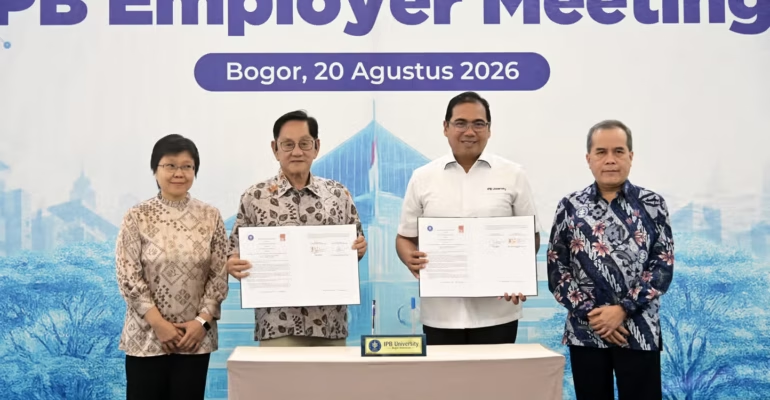
This was the focus of the IPB Employer Meeting 2026, titled “IPB’s Talent Management Transformation in Responding to Industry Needs,” held on Thursday (8/20). This forum served as a platform bringing together IPB University with its partners, industry representatives, and employers of its graduates.
Rector Dr Alim Setiawan Slamet stated that the transformation of IPB University’s talent management is designed so that students do not merely graduate with a degree, but also understand their potential and career paths.
“IPB is developing AI-based talent management and talent assessment in the seventh semester to map students’ strengths, areas for development, and career paths,” he said.
Bogor Mayor Dedie A. Rachim also highlighted opportunities for Indonesian workers in the global market, particularly in Japan. He noted that he had met with approximately 10 Japanese vocational training institutions (LPK) that require up to about 30.000 workers from Indonesia per year.
“If we can play a role there especially since Japan is currently facing a severe aging society issue this represents a huge opportunity for us,” said Dedie.
Endang Sulastri, SSos, MPP, Director of Higher Education, Science, and Technology at the Ministry of National Development Planning (Bappenas), stated that there are approximately 328.900 job order in the global labor market, primarily in the manufacturing, construction, healthcare, and hospitality sectors.
Therefore, she emphasized that universities need to equip students with in depth disciplinary knowledge, data literacy, digital literacy, and artificial intelligence (AI) skills, green skills, the ability to understand systems and regulations, as well as soft skills.
Meanwhile, Assistant for Economic and Development Affairs of West Java Province H Sumasna, ST, MUM, emphasized the importance of aligning higher education with the needs of the workforce through industry based learning, collaborative research, and innovation development.
The forum then continued with a discussion session moderated by Puji Mediana, SP, MA, Director of Career Development, Entrepreneurship, and Alumni Relations at IPB University. This session featured Prof Taufik, a representative from the Faculty of Engineering and Technology, Dr Berry Juliandi, Dean of the Faculty of Mathematics and Natural Sciences (FMIPA), and Prof Noer Azam Achsani, Dean of the School of Business.
During the session, the deans outlined the direction for educational development and graduate competencies in their respective fields. The Faculty of Engineering and Technology (FTT) emphasized strengthening agromaritime-based engineering education and learning through capstone projects. The Faculty of Mathematics and Natural Sciences (FMIPA) shared perspectives on competency development in the sciences, while the School of Business focused on shaping practitioners, professionals, and entrepreneurs.
Through the 2026 Employer Meeting, IPB University is promoting collaboration with industry in curriculum development, research, talent recruitment and development, and community empowerment. IPB graduates are expected not only to be job seekers but also to be problem solvers, innovators, and job creators. (Ez) (IAAS/FHD)