IPB University Professor and Doctoral Students Submit Six Family Protection Policy Briefs to Commission V of West Java DPRD
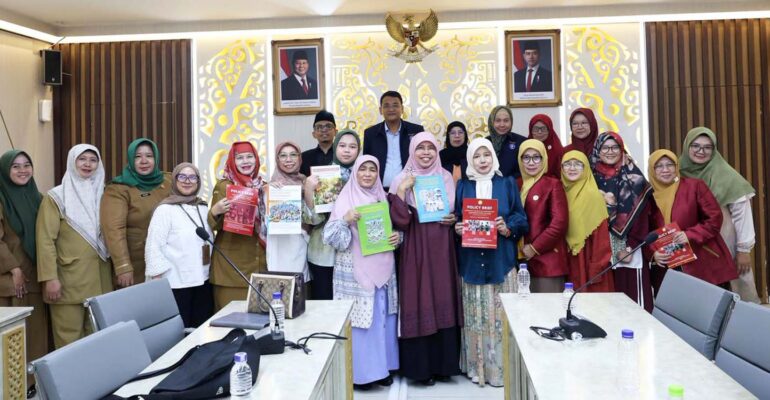
Doctoral (S3) students from the Family Science Study Program at IPB University participated in an audience and advocacy session with Commission V of the West Java Regional Legislative Council (DPRD Jabar). The session addressed the urgency of the West Java Draft Regional Regulation (Raperda) regarding family protection from various threats and conditions that increase family vulnerability and crisis.
During the meeting, student representatives strengthened the aspirations for the urgency of the Family Protection Raperda based on family science, elaborating through theories, research findings, data, and existing phenomena.
IPB University Professor, Prof Euis Sunarti, acting as the student advisor, emphasized that regional development should be family-friendly. This vision is realized through the development of family-friendly regions and workplaces, implemented at the smallest level: the Family Friendly Village (Kampung Ramah Keluarga).
On this occasion, Prof Euis Sunarti submitted her work in the form of six policy briefs written between 2024–2025, concerning: (1) Family Friendly Development: placing the family as the basis for development policies and programs, (2) Family-Friendly Workplaces: foundations, reasons, and implementation challenges, (3) Family Friendly Villages: providing support, protection, and family resilience, (4) Indonesian Families and Contemporary Megatrends, (5) Disaster Risk Reduction through Investment in Indonesian Family Resilience, and (6) Comprehensive Sexuality Education: history, implementation, dangers, prevention recommendations, and handling solutions in Indonesia.
“Prevention is the core of protection, while family protection policies should be built using an ecosystem approach,” she stated while leading the IPB University student delegation.
She further noted, “Family issues cannot be solved partially. Families exist within an ecosystem involving individuals at the micro-system level, various communities and institutions at the meso and exo-system levels; up to institutions, policies, and programs at the macro level.”
Therefore, she emphasized that family protection policies must be designed holistically, in an integrated manner, and sustainably to address the root causes of the problems.
Responding to the presentation, several legislators and officials in West Java Province expressed their interest and desire to study Family Science at IPB University. (*/Rz) (IAAS/HNF)