IPB University’s OVOC Program Doubles Farmers’ Incomes in Tugu Mukti
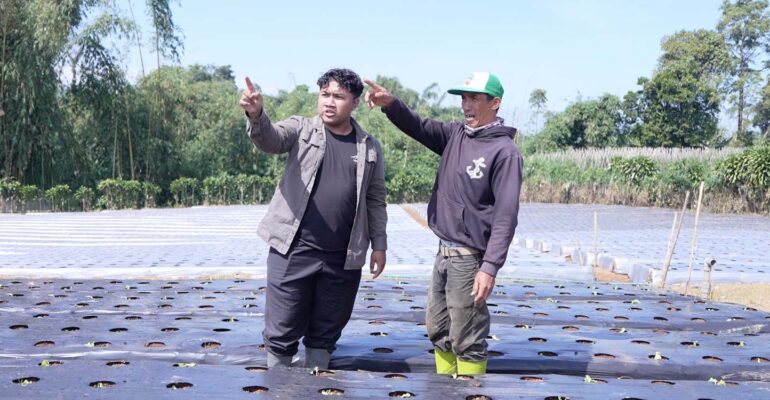
IPB University’s One Village One CEO (OVOC) program offers a solution to the long standing challenges faced by farmers in Tugu Mukti Village, Cisarua Subdistrict, West Bandung Regency. Through market mapping and technological support, the program provides market certainty while driving an increase in farmers’ incomes.
Until now, farmers have faced numerous challenges, ranging from price fluctuations, short shelf life of crops, long distribution chains due to middlemen, to market uncertainty.
Muhamad Rizki Hadi Pratama, the OVOC CEO for Tugu Mukti Village and a student in the Silviculture Program at IPB University, explained that OVOC offers a solution by mapping three market segments: modern markets, regional retail, and local markets.
“This scheme helps farmers secure guaranteed absorption of their harvests while reducing their reliance on middlemen. This market mapping and segmentation has been consistently implemented for the past six years,” he said.
Additionally, technological innovation is further enhanced through the use of IPB University’s automatic weather stations (AWS), which help farmers monitor weather conditions more accurately. Data such as rainfall, temperature, and humidity are utilized as the basis for cultivation decisions to mitigate production risks. This technology has also been in use for the past six years.
On the post-harvest side, ozonation technology developed in collaboration with researchers from IPB University has been able to double the shelf life of horticultural products, particularly watercress. “With ozonation technology, the shelf life can be twice as long. This is very helpful because we’ve also entered international markets,” explained Hadi.
Price stability is one of the tangible impacts of this program. “Before OVOC, watercress could cost as much as 500 rupiah per kilogram. After we were able to maintain supply stability, prices stabilized at 15.000–16.000 rupiah per kilogram,” he said.
Significant changes have also occurred in the distribution chain. Previously, the harvest had to pass through many intermediaries. “From local middlemen, to village middlemen, district middlemen, all the way to major distributors, before reaching the central market. Now it’s streamlined: from farmers to a distribution hub, then directly to modern markets,” he said.
Through this scheme, “The selling price is set jointly with the farmers with a minimum margin of 10 percent above the cost of production (HPP),” explained Hadi, emphasizing the agreement between the program managers and the farmers.
Hadi hopes the OVOC program can be expanded to various regions in Indonesia so that more farmers can benefit from innovation, mentoring, and better market access. (Fj) (IAAS/KQA)