
In Support of FOLU Net Sink 2030, IPB University Engages 1.188 Farmers to Plant Tens of Thousands of Trees in Sukabumi
The Department of Forest Resource Conservation and Ecotourism at IPB University, through its FOLU Net Sink Implementing Partner, recently carried out a tree-planting activity involving 35.899 trees in Kabandungan Subdistrict, Sukabumi Regency, West Java.
This activity is part of efforts to support the FOLU Net Sink 2030 target in the forestry sector while contributing to improving the welfare of communities in villages bordering the Gunung Halimun Salak National Park.
The activity involved 1.188 farmers from four villages, Kabandungan, Cipeuteuy, Cihamerang, and Mekarjaya, covering a total land area of 269,97 hectares.
The seedlings planted consist of 33.899 multi purpose tree species (MPTS) and 2.000 forestry trees that have undergone a verification process for land suitability and local environmental conditions.
The selected MPTS are economically valuable plants such as durian, avocado, nutmeg, mangosteen, petai, and several other commodities. The forestry trees planted include rasamala, manglid, and ganitri.
This activity is supported by a Research Based Contribution (RBC) grant resulting from cooperation between Indonesia and Norway, and was carried out to commemorate International Forest Day.
In addition to focusing on planting, this program is also part of efforts to strengthen the management of indicative preservation areas for biodiversity conservation and to contribute to the Nationally Determined Contribution (NDC).
The entire process is carried out in a phased and participatory manner, ranging from outreach and technical training, such as geotagging, the production of organic fertilizers and environmentally friendly pesticides, to the distribution and acclimatization of seedlings.
The activity coordinator, Dr Rinekso Soekmadi, explained that this program employs a landscape approach that integrates conservation, increased carbon sequestration, and community well being.
“This approach is expected to create a balance between ecological functions and economic benefits for communities living near forests,” he said.
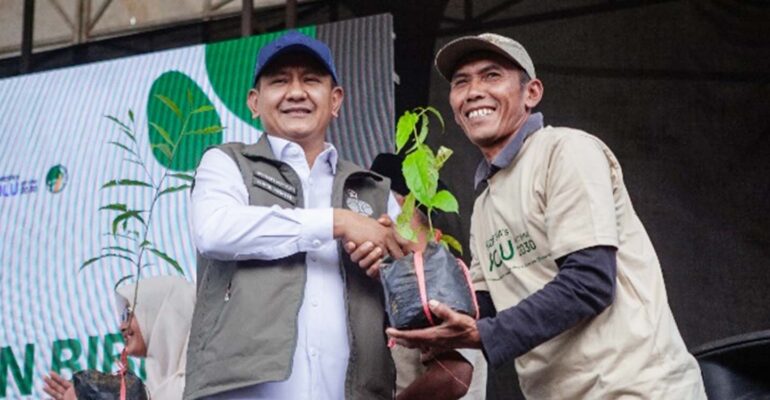
The event was also attended by Vice Minister of Forestry, Rohmat Marzuki, SHut, who provided guidance and symbolically handed over seedlings to representatives of the farmer groups. He expressed appreciation for the initiative and encouraged the expansion of similar programs to other buffer zone villages.
Dr Heti Mulyati, Vice Rector for Resource and Infrastructure Resilience at IPB University, also reaffirmed the institution’s commitment to supporting the development of similar programs in broader regions through cross sectoral collaboration.
In addition to the tree planting ceremony, the event also featured a dialogue among government officials, academics, and farmer groups. The discussion addressed various on the ground challenges, such as marketing agricultural products, sustainable land management, and strengthening farmer institutions.
This program is expected to serve as an initial step that can be replicated as a model for community-based landscape management in buffer zones, prioritizing synergy between environmental conservation and local economic development. (*/Rz) (IAAS/DAM)

