
IPB Himiteka Holds Training Course on Hydrobiology Using CPCE
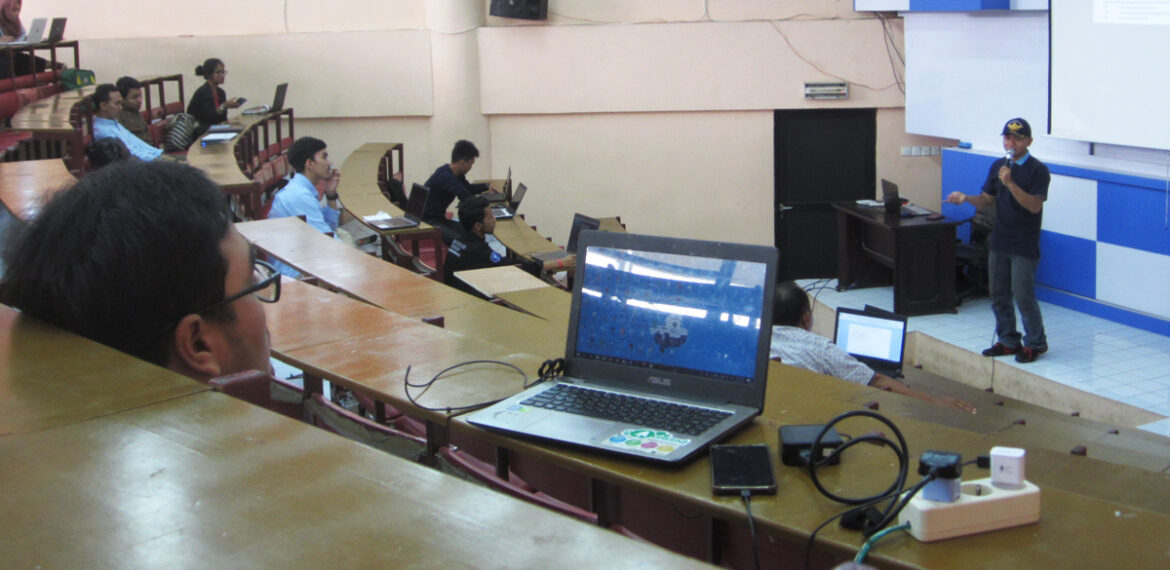
Marine Science and Technology Student Association (Himiteka), Faculty of Fisheries and Marine Sciences of IPB University (FPIK of IPB) conducted a Marine Hydrobiology Training Course entitled ‘Coral Reef Monitoring Techniques and Coral Identification Using Coral Point Count with Excel Extension (CPCE)’, Sunday (12/5). This training course was attended by students and the general public.
Coral reef monitoring activities are important to monitor developments and changes in coral reef ecosystems, and to take the various decisions needed.
The keynote speaker was Tri Aryono Hadi from the Oceanographic Research Center, Indonesian Institute of Sciences (LIPI). Various techniques in monitoring coral reefs were presented by him, such as manta taw, line intercept transect and underwater photo transect techniques. He explained that each technique and method has advantages and disadvantages depending on the objectives to be achieved.
“Manta taw technique requires professional person because the diver is pulled using a ship at a certain distance and the person tries to collectively record the condition of coral reefs cover fast. The data obtained may be very subjective if the diver is not an expert,” said Tri.
Tri added that a more accurate technique that can be used is underwater photo transect. By determining the line of observation using the line transect, the observer takes a photo on a coral object assisted by the frame as the boundary of the area that will be photographed. The frame is placed around the transect line and then transferred to the next object to be photographed with a consistent distance.
“This method (photo transect method) uses camera and frame, and can be used as evidence if we want to know the changes that occur in coral reef ecosystems,” he said.
From the results of monitoring, the data obtained is then processed using the CPCE application. The CPCE software was developed by Nova Southeastern University, United State. It is a free software that can be used to analyze photos to obtain data on the percentage of living coral cover, other appendix categories, and the species name of the coral reefs.
“The file code in CPCE can be updated to the species level, so we can name the species in the CPCE analysis,” said Tri.
This Oceanographic researcher explained that the CPCE principle uses random points. “When we see a frame sizing 44 x 58 centimeters, we analyze the percentage of living coral cover based on random points. So later there will be random points scattered within the frame area. If the random point is on the reef, then we write ‘the coral’,” he explained.
He added, “The more corals live in that frame, the random points will be on the living corals. So the CPCE software is reliable for analyzing transect photos,” he explained. (IRM/ris/zsp)

