Rector Hopes for An Indonesia Development Breakthrough from IPB
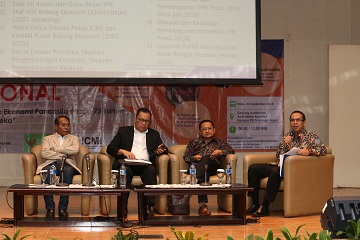
Rector of Bogor Agricultural University (IPB), Dr Arif Satria hopes that there will be an idea to manage Indonesia development model from IPB. This statement was delivered by IPB Rector at the National Seminar ‘Pancasila Economy Practice Evaluation Post-73rd Indonesia Independence’, which was held by Faculty of Economy and Management (FEM) IPB in coordination with National Industrial Econonmy Committee (KEIN), Indonesian Muslim Scholars Organization (ICMI) and TEMPO to commemorate 55th IPB Dies Natalis in Andi Hakim Nasoetion building, IPB Dramaga Campus, Wednesday (26/9).
IPB Rector said that Pancasila Market Economy was first readopted by Prof Dr Ing BJ Habibie. “This is an extraordinary idea, to manage a development model with society characteristics like any theory hasn’t been done. We need a significant breakthrough. IPB craves for major theories initiated by Indonesia universities. IPB has a big potential in encouraging the discovery of those theories, I hope major theories will emerge from our university,” said IPB Rector. Moreover, the Rector also said, “We hope we will create our own development model. We can just create a new category. Not only theoritical in development structure but is also applicable on field.”
Dr Ir Nunung Nuryanto, Dean of FEM IPB added that when they were preparing for Indonesia’s independence, our founding fathers had thought that the basis of creating a nation is not only about politics, but also economy. “Economy sistem is supposed to be built according Indonesian values and spirit. This idea is related with people-based economy that corrects colonial system and becomes the middle ground that doesn’t adopt capitalism, but also not socialism by referring to Pancasila’s spirit. This system is well known by Pancasila economy system.”
According to Dr Nunung, this concept of people-based economy is written in UUD 1945 Article 33 that stated that the expected business model is cooperation to serve as the pillar for national economy. After 73 years after Indonesia’s independence, this concept has its ups and downs in practice, tugs, and debates.
When educating, it is expected for academicians to not only teach about capitalistic or socialistic economies, but also about Pancasila economy system. These various dynamics are summed up in this national seminar. In addition to that, Prof Didin S Damanhuri, IPB economist, put attention on Pancasila market economy practices in which market stakeholders (State-owned Enterprise, private companies, cooperations) operate in market mechanism to achieve welfare (economic growth) accompanied with social justice (welfare distribution). Religion takes role to ensure personal, family, and country’s good behaviours.
Dr Arif Budimanta, KEIN Vice President, who is also IPB alumnus reported that KEIN in the last two years travelling to various universities to create cooperation with Indonesia Economics Bachelors Organization, and talk about Indonesia’s economy system. “It’s hard to expect an academician to have a thought about Indonesia economy system to find out what is the ideal economy system for Indonesia,” said Dr Arif. Pancasila economy system, according to Dr Arif, is a regulator of international and national relations which has a purpose to advance humanity and civilization, strengthen national unity through gotong royong, by conducting economy access distribution fairly with God as the foundation. “We hope by understanding about Pancasila economy practices, our national identity will be maintained in the midst of global competitions that can erase our nationalism,” he said. Fachry Ali added that Pancasila market economy is a structure of tolerance guided by nation, religion, and value system that flourishes in society with grass-root economy. (Ard)